Translate

Tuesday, November 29, 2011

Aquinas


Dr. Walter Stein says that Aquinas represents the "true" Manicheism and criticizes the false which had become a "travesty"- Note 10, Chapter 4, The Ninth Century.
"In response to the opposition of Manichaean dualism Aquinas emphasises that the union of body and soul is essential for humans, and that it is to the advantage of both body and soul. "To be united to body is not to the detriment of the soul but to its enrichment. There is the substantial benefit of completing human nature, and the accidental benefit of achieving knowledge that can only be acquired through the senses".
"He says that our body substance is not from an evil principle, as the Manichaeans imagine, but from God. "By the friendship of charity, by which we love God should we cherish the body." In his opinion the psycho-somatic interdependence goes so far that the quality of intellectual life depends on the quality of the body. When the body is a hindrance for the achievements of the higher aims of human life, it is not due to its being body, but to sin which corrupts the body and disturbs the harmony between body and soul."
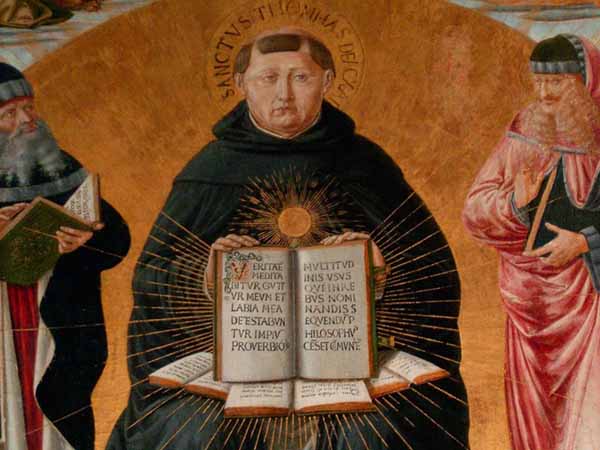
As you can see, the doctrine he was opposing was one of the Lucifer-Gnosis. 

An interesting point Dr. Stein makes is that Aquinas was a descendant of Landulf II of Capua (Klingsor). (Family tree given by Erchempertus quoted in The Ninth Century, Chapter 6, note 8.)

Aquinas was not so tolerant of heretics (advising they be put to death):
Aquinas and the Heretics:
"With regard to heretics there are two points to be observed, one on their side, the other on the side of the Church. As for heretics their sin deserves banishment, not only from the Church by excommunication, but also from this world by death. To corrupt the faith, whereby the soul lives, is much graver than to counterfeit money, which supports temporal life. Since forgers and other malefactors are summarily condemned to death by the civil authorities, with much more reason may heretics as soon as they are convicted of heresy be not only excommunicated, but also justly be put to death.

"But on the side of the Church is mercy which seeks the conversion of the wanderer, and She condemns him not at once, but after the first and second admonition, as the Apostle directs. Afterwards, however, if he is still stubborn, the Church takes care of the salvation of others by separating him from the Church through excommunication, and delivers him to the secular court to be removed from this world by death. The Decretum repeats Jerome's comment, "Cut off the decayed flesh, expel the mangy sheep from the fold, lest the whole house . . . the whole body, the whole flock burn, perish, rot, die. Arius was but a single spark in Alexandria, but as it was not at once put out, the whole world was laid waste by his flame."


Monday, November 28, 2011

Neo-Manicheism

Some of the doctrines claimed for Neo-Manicheism might be challenged. The main one being that the creator of the material world is evil - that being a Lucifer/Gnosis idea.

There is very little left from the original Church. However, there plenty of reincarnated souls today, who have been involved in the Manichean stream.

Somewhere in a hill village, near Quanzhou in China, there still exists a Manichean temple which is now Buddhist.  The underground spiritual stream itself has never died. It continued on in the Grail Mysteries, for instance.

This blog puts together some of the history and teachings of Mani, much of which was revealed by writers in the twentieth century beginning with Rudolf Steiner. There is more to post from Trevor Ravenscroft, Sergei Prokovieff and Walter Stein et al. Later we will flesh out the doctrines - ablutions, water communion, Zodiac and the Trinity etc.

Albert Steffen, the first leader of the Anthroposophical Society after Steiner was a Manichean. Dr. Steiner himself was a Rosicrucian - a path closely allied to the Manichean.

The Manichean path is characterized by tolerance, gentleness, kindness and forgiveness. It has elements of Buddhism (the eightfold path in particular), Zoroastrianism, Pythagoras and Empedocles (the teaching of the Four Elements - how they relate to the Zodiac and the individual, is an informing study).

The Manicheans used water in their Eucharist.


By Zhangzhugang 


Sunday, November 27, 2011

The Two Roots

Night- Michelangelo
The Two Roots (Dō Bun in Persian) are Light and Dark. The Tree of Life and the Tree of Death.

As posted before, the teachings of the Greek
scholars, Empedocles and Pythagoras were passed down to Mani by the
great teacher Scythianus, whom it is said, lived at the time of the Apostles.

Scythianus, by the way, still remains as one of the great teachers of humanity.

Empedocles is a source for the doctrine of the four elements, even as it manifests itself in Hippocrates' teaching of the four humours. This is a very practical doctrine which is used widely even today.

Empedocles also taught that the universe is composed of the forces of Neikos: Strife/Discord and Philia: Love/Friendship. Here is another source for the Manichean Two Roots.

Day- Michelangelo
"The difference between these two Principles is like that between a King and a pig: Light dwells in a royal abode in places suitable to its nature, while Dark like a pig wallows in mud and is nourished by filth and delights in it." - Severus, quoting a work by Mani.

Saturday, November 26, 2011

The Three Moments


The Three Moments are of time - past/old/former, present/current and the future/changing. These qualitative differences can be applied to the Zodiac. The arrow must hit the target- not a little to the left or right.

This is the lofty doctrine that purpose be exercised deftly. For example, you go to a concert on the stage is a man with a hammer making a piano i.e. what should have taken place in the past is manifesting in the present. Again you turn up, and find that the pianist played yesterday and you have missed the show. (An example given by Rudolf Steiner.)

Here is one definition of evil: goodness must not fall either side of its allotted time - or that evil can be misplaced goodness.

In terms of evil we can have the rotten - old evil represented by Ahriman - and the unripe - young evil represented by Lucifer. Christ lives in the present, where everything is at its peak.


Friday, November 25, 2011

Mani & the Pivot of this Present Moment

"We can truly cherish the dear souls that we share company with, without the necessity to explain such rapport by the past. The grand moment is undeniably now."
It is wise to remember that the great personage of Mani has gone further on in his development since he played that pivotal role in the third century of our era. By only concentrating on the man of the past we separate ourselves off from the reality and truth of the current manifestation of he who was Mani.

"If we look to study the ghosts and their times passed, it is necessary to distinguish the then from the now."
There are many souls incarnating today who have had experience in the Manichaean stream. And as is the case with many reincarnates they hearken back to those powerful impressions that once filled their souls. 

It is a truth that change is the only constant and that the grand moment is now. And so the Manichaean stream is very much alive and lives in the now. It is by no means a force that is spent. Indeed its time has not come, and it is set to play an important role in the future.
"The wise ancients that you call upon in vision, were marvelous in their special moments, in their prime, in those 'cameo performances', and we may give thanks also to the great souls who have shaped the world thus. However, you will separate yourself from the reality and truth of their current personages if you indeed forget that they too have gone further."
"The riches of the past are the most hallowed and revered illusions beyond all others. No matter how good the teacher or how ecstatic the exquisite review, the past is nonetheless, that which has been; and though immortalized in fragments everywhere, it is an illusion best realized as such from the outset. It becomes a necessary discrimination before attempting to enter back into the streams of influence which hold great attraction in heart and desire."
-B.Hive

All quotes from The Three Moments


Thursday, November 24, 2011

City of Shapur

Shapur 1
Gondishapur (or Jundishapur) was the city founded by Shapur 1 in the 3rd century AD. It is where Father Mani met his martyrdom. 

The site of this misdeed, where his body was hung, was known forever after as Mani's Gate.

Jundishapur was to be later the site of the most remarkable learning center in Persia: The Academy of Jundishapur.

The Academy of Jundishapur was formally set on its way when the Roman emperor Justinian closed the Academy in Athens in 529 AD, and the displaced Greek scholars moved to Jundishapur in southern Persia.

The Founder of Jundishapur
A Bishop of Edessa in 545, enforced the decrees of the Council of Chalcedon against the Nestorians in his diocese, and some of them also migrated to Persia.

Wednesday, November 23, 2011

Gospel of Mani Papyrus


The Gospel of Mani, is written on blackened papyrus.

"In its day, it was one of the greatest books to survive from the ancient world."

"They [the MSS] were caught up in the collapse of the Third Reich, taken to Russia, and has finally ended up in the Chester Beatty Library in Dublin.

"Some pages were placed in a bunker under Berlin Zoo for safety"

"Others were kept by Ibscher, who took them to Bavaria to continue his restoration."

"When Berlin was conquered by the Russian army, the manuscripts were discovered by the Russians and taken to Leningrad."

"Michael Ryan, director of the Chester Beatty Library, said: "It is remarkable that after all this historical messing around that the gospel is now back together again in Dublin"."

A fragment of a writing ascribed to Mani, in Sogdian and Persian:

Manichean Musicians
Illumination from Qoco, East Turkestan
Museum für Indische Kunst, Berlin
The most Beloved Son, the Savior Jesus, the head of all these gifts,
Who is a refuge for the holy and a blessing for the wise, is exalted.
May he be praised!

The Maiden of Light, the chief of all wisdom, is exalted.
May she be praised!

The Holy Religion, by the power of the Father,
by the blessing of the Mother and by the wisdom of the Son, is exalted.
May it be praised!

Well-being and blessing to the sons of goodness
and to the speakers and hearers of the true Word!
Praise and honor to the Father and the Son
and the Holy Spirit and to the holy recollection!

He (Mani) teaches the word of the Living Gospel
for Eye and Ear, and he preaches the fruit of righteousness.

I, Mani, the Apostle of Jesus the Friend, by the will of the Father,
the true God, of Him, by whom I have become ...
Everything that is and everything that was and will be is by His Power.
The blessed ones will receive this message,
the wise ones understand it,
the strong ones will take on the wisdom of the wise ....