According to Rudolf Steiner (Anthroposophy) the prophet Mani began a stream of Christianity which will have great tasks in the future when Good confronts Evil. The elements of this path and how it relates to the Rosicrucian path and the Grail Christianity of Parzifal/Parsifal/Percival will be discussed here. It is also mentioned by Max Heindel of the Rosicrucian Fellowship. The Cathars, Albigenses,Waldenses and Knights Templar were in one way or another a continuation of the stream.
"Manichaeism recognised a reality in which sense and super-sense are blended; for it the words and concepts "matter and "spirit" have as yet no contrasting meaning."
"In defining it, it must be pointed out that the general outlook of this philosophy is more important than what can be described as its actual content. The first and most remarkable thing about it is that the division of human experience into a spiritual and a material side had no meaning for it. The words or ideas "spirit" and "matter" convey no distinction to it. It sees the spiritual in what appears to the senses as material, and when it speaks of the spiritual it does not rise above that which manifests itself to the senses.
"It is true to say of Manichaeism- much more so than the abstract and intellectual world of today can realise- that it actually saw spiritual phenomena, spiritual facts, in the stars and their courses, and that in the mystery of the Sun it saw a spiritual reality manifesting itself to us on earth. It conveys no meaning for Manichaeism to speak of matter and spirit separately, for to the Manichaean what is spiritual manifests itself in the form of matter, and that which appears as material is itself spiritual.
"Therefore Manichaeism speaks quite naturally of astronomical things and world-phenomona in the same way that it would speak of moral phenomena or happenings within the evolution of the human race. Thus, the existence side by side of "light" and "darkness" which - imitating something from ancient Persia- it embodies in its philosophy is both a physical and a spiritual fact. In the same way Manichaeism speaks of the Sun in its movements in the heavens as related to the moral realities and impulses in the development of mankind. It sees the relation of this "spiritual physical" Sun to the signs of the Zodiac, as the relation of the Original Being, the source of the world's light, to the twelve Beings through whom He delegates his activities."
Look at the light as it touches unevenly all that it falls upon. See here a shadow, see here a great spark, on the leaves, on the tops of that which it fires. There are gradients of light, the way in which the scene is lit, and one may focus best upon the shadows, or upon the most brilliant. Seek, with your eyes, the shiniest, brightest places within the scene. Go to them, and ask, what inhabits these brightest places. They will shift, but they will be present, wherever kissed by the radiance. They are much illumined. Keep looking. See where it is the light falls, and know that this makes a difference, not only to your vision, but to those places where it is most intense. It may be in reflection, it may be in direct sunshine, look around to the brightest places, keep looking.
"Oh, Great and Wonderful One, He who brings this Light: the Light, not in symbol, but in actuality - where should we be, without this intensity? I am humbled, I am grateful, I rejoice this vision granted. And I know, that help is at hand, wherever Thy Radiance falls. Pure Light. Why do I take thee for granted? Why have I cared not to see you? I look to all else, that by your Power, is made known to me, but not at the actual Light itself. The brightest part of the Light."
Look, really look, into the those places lit so brightly: look, at the light itself. By contrast we may experience those places where the light is at its brightest - it is the very contrast that enables us to do so, and it would be hard to imagine a world without contrast, if all images were indeed the same, without the palette of gradient light. -B.Hive 🌞
In some dim way, to realize the etheric as etheric, then one begins to move forward into a kind of new and more intimate relationship with the world of plants. One begins, for instance, to feel, like a sort of tenderness in one's own heart, the infinite delicacy and tenderness that hovers about the growing point commonest weed. And at the same time or it may well be later - it come about that one will begin to feel a new, and again an intimate, relation with the light itself. One begins to perceive, or rather to feel, that the light itself- this light from the sun that comes to us through the senses - is etheric and that the etheric is a kind of light.
And this is a very deeply moving experience. Much deeper than mere observation. It goes to the roots of one's being, like the breath of life itself. One will begin to feel that the light is not only outside in space, but also within oneself. Indeed there are sure to be occasions when, for brief periods, one is aware, not only of seeing or feeling the light, but also of breathing it. Breathing it in and out, but especially in.
Only a much more intimate kind of breathing so that one will feel –at times that one is in the light, not only as our bodies are in water when they swim, not only as they are in the air we breathe, but rather as we speak, in that significant English idiom, of people being in love. If one had to find a single word in which to sum up the more subjective aspect experience I am speaking of, there is only one word that could be used and that is - joy. The sort of joy that we see made manifest in the sunlight dancing on the water. Deep draughts of pure joy, which obliterate, while they last all anxiety, all sorrow, all considerations of karma, and even all memory of such things. A joy so uplifting and, if I may use the word, so thoroughgoing, that however short a time it lasts, it will leave some enduring effects behind it. It may indeed somewhat affect the whole personality - with reverberations even into the sphere of physical health.
"All
this is closely connected with a figure who glimmers across from the
Middle Ages as a legendary being, but is well know to anyone acquainted
with the nature of the Mysteries: a personality who was quite real in
the middle of the Middle Ages, Klingsor, the Duke of Terra de Labur, a
district we have to look for in what is now Southern Calabria.
From
there were carried out the incursions of the enemy of the Grail,
especially over to Sicily.
Even as today, if we tread Sicilian soil and have occult sight, we are
aware of the Akashic after-effects of the great Empedocles still present
in the atmosphere, so we can still perceive there the evil
after-effects of Klingsor, who allied himself from his Duchy of Terra de
Labur, across the Straits of Messina, with those enemies of the Grail
who occupied the fastness known in occultism and in legend as Calot
bobot." -Rudolf Steiner
"Calot Bobot" or "Kalot Enbolot" - from the Arabic Qalat-al-ballut - means"Castle of the
Oaks". From there, African Mohammedan enemies of the Grail worked. The
symbol of the Grail is the Sun host held by the crescent Moon. The Moon
forces will be redeemed by the Sun. It is opposed by the crescent with
the star (the false Venus?). So today we have the old
battle of the Sons of the Sun with the Sons of the Moon. Walter Stein
predicted the confrontation between East and West.
Working with the time cycles of Trithemius of Sponheim he saw a replay of the battle of Salamis
of 480 BC, where the Persians were beaten back by the Greeks. He
predicted that two old enemies would have to cooperate if the battle
were to be won.
"In the middle of the
Middle Ages, Calot Bobot in Sicily was the seat of the goddess called
Iblis, the daughter of Eblis; and among all evil unions which have taken
place within the Earth's evolution between beings in whose souls there
were occult forces, the one known to occultists as the worst of all was
between Klingsor and Iblis, the daughter of Eblis. Iblis, by her very
name, is characterized as being related to Eblis, and in Mohammedan
tradition Eblis is the figure we call Lucifer.
"Iblis is a kind of
feminine aspect of Eblis, the Mohammedan Lucifer, and with her the evil
magician Klingsor united his own evil arts, through which in the Middle
Ages he worked against the Grail. These things must needs find
expression in pictures, but in pictures that correspond to realities;
they cannot be expressed in abstract ideas. And the whole of the
hostility to the Grail was enacted in that fastness of Iblis, Calot
bobot whither the remarkable Queen Sibilla had fled with her son William, in 1194, under the rulership of the Emperor Henry V1." -Rudolf Steiner
As
the story goes, Klingsor was found in bed with the king of Sicily's
wife, Iblis. For this indiscretion Klingsor had "yield his manhood to
the king in satisfaction". -Walter Stein The Ninth Century
As a result Klingsor was made a "capon" a "castrated cock".
May we commit to the higher path, and not the stupidity of Klingsor. "Death
dies. Evility does not thrive; it exists, corrupts and then falls to
its own design. Hatreds are self-inflicting. Even the wars in Heaven are
but a thumping and a clanging of but a toy drum and cymbal to the
serene and holy hierarchies.
"By their own nature those who offend
Father God by their intent, by their behavior, will be unarmored,
incapacitated and laid victim to the same ranks they themselves have led
through their short-lived victories.
"Then let them step amongst the slush of
once flesh, and feel the edge of every tendon, every sinew - for each
sightless eye, twisted or dismembered limb, for any premature and
violent end, they too, in trade, shall be thus unendowed.
"Where now the strength that once was arm? Cannot the finger point, or curl - Or hold thy heavy crown?"
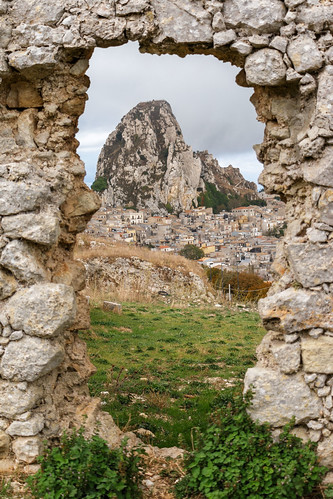
The ancient town of Triokala was destroyed and rebuilt in the Ninth Century by the Arabs under the name of "Kalat al ballut" (stronghold of the oaks). Here in 1091 King Roger (1031-1101) defeated the Arabs, and in memory of the victory he erected a temple to St. George. The Normans built a castle, where in 1302, between Frederick II of Aragon (1272-1337) and Charles of Valois (1270-1325), the Treaty of Caltabellotta was signed after the war of Vespers, and the island was ceded to the Aragonese. Caltabellotta became a county in the mid-14th century when King Peter of Aragon (1319-1387) granted the title to Raymond Peralta, who became the poweful Earl of Caltabellotta. The county was ruled by the Peralta until the fifteenth century, when it passed for matrimonial law to the family of De Luna.
The Spanish rule lasted at Caltabellotta until the early 18th century; then the town passed to the Bourbons and finally it entered into the newly formed Kingdom of Italy in 1861. Caltabellotta: it starts with a legend
According to legend, when Daedalus, the inventor of the Labyrinth, fled from the anger of King Minos, he took refuge on Sicily with Cocalus, a powerful Sicanian king, where he lived for a while and filled the island with his fame. Here he also built 'Kamikos', a city on a rock that was absolutely impregnable.
Meanwhile, King Minos prepared an invasion, and on landing in the territory of Agrigento he turned against Kamikos, asking Cocalus to deliver Daedalus to him. Using deception, Cocalos invited him to a meeting and received Minos hospitably. While Minos went for a bathe, Cocalus 'detained' him in the hot water, that killed him, and then returned the body to the Cretans, saying that he had fallen into the hot water and died.
Schubring emphasized that the legend disguised the fact that Cocalos and Kamikos were attacked by an army from Crete. Schubring's intuition was confirmed by contemporary studies:
“The mythological basis for the military expedition of Minos, in search of Daedalus, who escaped from the Labyrinth and took refuge at the court of the Sicanian King Cocalus, reveals the historical reality of a possible military confrontation between the ancient military powers for the control of the Mediterranean routes, trades and technologies”.
According to tradition, Kamikos was perhaps destroyed in the age of Theron, the tyrant of Akragas (540-472 BC), and abandoned by its inhabitants. With the disappearance of Kamicos, "Triokala" made its appearance. The Greeks called the city by a name that identifies its main properties, namely "Triokala" = three good things: water, fruit, and impregnability.
However it is not a foregone conclusion that Triokala appeared after the disappearance of Kamikos. According to Schubring, Triokala was the fortress of Kamikos, situated on a rocky peak overlooking the town - hence Triokala was the fortress (frourìon) of Kamikos, and the vantage point of the slaves during the first Servile War in Sicily (134-132 BC).
The position of Triokala coincides perfectly with the current town of Caltabellotta.
"Those who advocate using the crucifix in the Syro-Malabar CatholicChurch instead of the Mar Thoma Cross claim that the Mar Thoma Crossis actually the "Manichean Cross" a symbol of Manicheanism (aheretical early Christian sect that blended Christian and Zoroastrianbeliefs and whose founder, Manichee, claimed to be the incarnation ofthe Holy Spirit)."
The cross has a dove above it representing the Holy Spirit. The lotusbelow is meant to represent the Father. The lotus in the East alsorepresents the flowering of great beauty from the sludge and slime.Perhaps here, another symbol of the good overcoming eviland its results.
The following is about the fuss this cross has caused in the MarThoma Church:
"The warring factions in the Church could be described as thetraditionalists and the reformists. The traditionalists maintain thatthe Syro-Malabar Church is a daughter-Church of the Chaldean Churchwith headquarters in Baghdad. They are for the adoption of the wholeEast Syrian (Chaldean) liturgy said to be prevalent in the Church inKerala from the fifth century to the 16th century when the LatinChurch established its sway with the advent of the Portuguese.
"According to the reformists, the traditionalists are for the removalof the crucifix and abolition of prayers like Rosary and Way of theCross among other things and for the introduction of `Chaldeanvestiges' like the Persian Cross, sanctuary veil and `Bema,' (aseparate table to be placed in the front or in the middle of theaisle).
"The crucifix has disappeared from many convents which easilysuccumbed to the Chaldean propaganda,'' says noted religious scholarProf. Scaria Zacharia. The crucifix, a matter of great religious andemotional attachment is beingreplaced by what is called the `MarThoma Cross'. The reformists contend that this cross is the ManicheanCross, a symbol of a heretic Church of a non-Catholic origin, whichhas since become defunct."
Lucifer and allother adversarial spirits can only live within the Holy Spirit, as all life isencompassed by it. Aquote from Rudolf Steiner:
That man is capable of this, that he is capable of understanding Christ,that Lucifer, resurrected in a new form, can unite with Christ as the goodSpirit this, as prophecy still, was told by Christ Himself to those aroundHim, when He said: Ye shall be illumined by the new Spirit, by the HolySpirit!
This Holy Spiritis none other than the Spirit through whom mancan apprehend what Christ has wrought. Christ desired not merely to work,but also to be apprehended, to be understood. Therefore the sending of theSpirit by whom men are inspired, the sending of the Holy spirit, isimplicit in Christianity.
In the spiritual sense, Whitsuntide belongs inseparably to Easter. ThisHoly Spiritis none other than the Lucifer-Spirit, resurrected now inhigher, purer glory the Spirit of independent understanding,wisdom-inwoven. Christ Himself foretold that this Spirit would come to menafter Him, and in the light of this Spirit their labors must proceed. Whatis it that works onward in the light of this Spirit? The world-stream ofspiritual science, if rightly conceived! What is this spiritual science? Itis the wisdom of the Spirit, the wisdom that lifts into the full light ofconsciousness that in Christianity which would otherwise remain in theunconscious.
The torch of the resurrected Lucifer, of the Lucifer nowtransformed into the good, blazons the way for Christ. Lucifer is the bearerof the Light, Christ is the Light! As the word itself denotes, Lucifer isthe Bearer of the Light. That is what the spiritual scientific movementshould be, that is implicit in it.
Those who know that the progress ofmankind depends upon living apprehension of the mighty Event of Golgotha arethey who as the Masters of Wisdom and of the Harmony of Feelings areunited in the great Guiding Lodge of mankind. And as once the tongues offirehovered down as a living symbol upon the company of the apostles, sodoes the Holy Spirit announced by Christ Himself reign as the Light overthe Lodge of the Twelve. The Thirteenth is the Leader of the Lodge of theTwelve. The Holy Spirit is the mighty Teacher of those we name theMasters of Wisdom and of the Harmony of Feelings.
It isthrough them thathis voice and his wisdom flow down to mankind in this or that stream uponthe earth. The treasures of wisdomgathered together by the spiritualscientific movement in order to understand the universe and the Spiritstherein, how through the Holy Spirit into the Lodge of the Twelve; andthat is what will ultimately lead mankind step by step to free,self-conscious understanding of Christ and of the Event of Golgotha. Thus tocultivatespiritual science means tounderstand that the Spirit has beensent into the world by Christ; the pursuit of spiritual science is implicitin true Christianity.
We find in "Parzifal" that his mother, the pregnant Herzeleide, nursesa young dragon in a dream:
For she did nurse a dragon, that
forth from her body sprung, And its dragon-life to nourish awhile at her breast it hung, Then it fled from her sight so swiftly..
The ultimate redemption of Evil through Good appearsin Mani himself.
Mani speaking at the age of 24:
"This is how everything that
has happened and that will happen was unveiled to me by the Paraclete",
Mani says in the Kephalia, mentioning "everything the eye shall see, and
the ear hear, and the thought think".
"I have understood by him
everything. I have seen the totality through him. I have become a single
body with a single spirit." "The divine counterpart will appear and bring help to
every apostle (Keph. 36: 6–9)" and not just one person.
The city of Petalamund (Petal Mount) appears in verses in Eschenbach'sParsifal. It has sixteen gates and is besieged by a black (Blackamoor)army on eight of the gates and a white army on the other eight. Here is apicture of the throat lotus blossom or chakram. Eight of the petals (those besieged by the Moorish army) have been developed through grace, the othereight require working on by the individual.
This is a most practical way in the which noble eightfold path has beenincorporated into the Christian context.
Rudolf Steiner suggested these exercises for students who wished to enhancethese qualities: Forthe Daysof the Week The pupil must pay careful attention to certain activities in the life ofsoulwhich in the ordinary way are carried oncarelessly and inattentively. There are eight such activities. It is naturally best to undertake only one exercise at a time, throughout aweek or a fortnight, for example, then the second, and so on, thenbeginning over again. Meanwhile it is best for the eighth exercise to becarried out every day. True self-knowledge is then gradually achievedand any progress made is perceived. Then later on - beginning with Saturday - one exercise lasting for about five minutes may perhaps beadded daily to the eighth so that the relevant exercise will occasionallyfall on the same day. Thus:Saturday - Thoughts; Sunday - Resolves;Monday - Talking; Tuesday - Actions; Wednesday - Behavior, and soon. SATURDAY To pay attention to one's ideas. To think only significant thoughts. To learn little by little to separate inone's thoughts the essential from the nonessential, the eternal from thetransitory, truth from mere opinion. In listening to the talk of one's fellow-men, to try and become quite stillinwardly, foregoing all assent, and still more all unfavorable judgments(criticism, rejection), even in one's thoughts and feelings. This may be called: `RIGHT OPINION'. SUNDAY To determine on even the most insignificant matter only after fullyreasoned deliberation. All unthinking behaviour, all meaningless actions,should be kept far away from the soul. One should always have well-weighed reasons for everything. And one should definitely abstain fromdoing anything for which there is no significant reason. Once one is convinced of the rightness of a decision, one must hold fastto it, with inner steadfastness. This may be called: `RIGHT JUDGMENT'. having been formed independently of sympathies and antipathies. MONDAY Talking. Only what has sense and meaning should come from the lips ofone striving for higher development. All talking for the sake of talking -to kill time - is in this sense harmful. The usual kind of conversation, a disjointed medley of remarks, shouldbe avoided. This does not mean shutting oneself off from intercoursewith one's fellows; it is precisely then that talk should gradually be ledtosignificance. One adopts a thoughtful attitude to every speech and answer taking all aspects into account. Never talk without cause - be gladlysilent. One tries not to talk too much or too little. First listen quietly;thenreflect on what has been said. This exercise may be called: `RIGHT WORD'. TUESDAY External actions. These should not be disturbing for our fellow-men.Where an occasion calls for action out of one's inner being, deliberatecarefully how one can best meet the occasion - for the good of the whole,the lasting happiness of man, the eternal. Where one does things of one's own accord, out of one's own initiative:consider most thoroughly beforehand the effect of one's actions. This is called: `RIGHT DEED'. WEDNESDAY The ordering of life. To live in accordance with Nature and Spirit. Not tobe swamped by the external trivialities of life. To avoid all that bringsunrest and haste into life. To hurry over nothing, but also not to beindolent. To look on life as a means for working towards higherdevelopment and to behave accordingly. One speaks in this connection of `RIGHT STANDPOINT'. THURSDAY
Human Endeavor. One should take care to do nothing that lies beyondone's powers - but also to leave nothing undone which lies within them. To look beyond the everyday, the momentary, and to set oneself aims andideals connected with the highest duties of a human being. For instance,in the sense of the prescribed exercises, to try to develop oneself so thatafterwards one may be able all the more to help and advise one's fellow-men - though perhaps not in the immediate future. This can be summed up as: `TO LET ALL THE FOREGOING EXERCISES BECOME A HABIT'. FRIDAY The endeavor to learn as much as possible from life. Nothing goes by us without giving us a chance to gain experiences thatare useful for life. If one has donesomething wrongly or imperfectly, thatbecomes a motive for doing it rightly or more perfectly, later on. If one sees others doing something, one observes them with the like endin view (yet not coldly or heartlessly). And one does nothing withoutlooking back to past experiences which can be of assistance in one'sdecisions and achievements. One can learn from everyone - even from children if one is attentive. This exercise is called: `RIGHT MEMORY'. (Remembering what has been learnt from experiences). SUMMARY To turn one's gaze inwards from time to time, even if only for fiveminutes daily at the same time. In so doing one should sink down intooneself, carefully take counsel with oneself, test and form one'sprinciples of life, run through in thought one's knowledge - or lack of it -weigh up one's duties, think over the contents and true purpose of life,feel genuinely pained by one's own errors and imperfections. In a word: labor to discover the essential, the enduring, and earnestly aim at goalsin accord with it: for instance, virtues to be acquired. (Not to fall intothemistake of thinking that one has done something well, but to strive everfurther towards the highest standards.) This exercise is called: `RIGHT EXAMINATION'.
Receive the Godhead right into your willing And it comes down from its cosmic throne. -Schiller
Following, are a few interesting passages on the will and its training from Friedrich Rittelmeyer's Meditation. He makes the point that before will must come feeling:
"To Thee Divine Ground of theworld- I turn my willing! May the power of this willing spring from feelingthat unites itself with Christ, Who liveth in Thy Life..." -Act of Consecration of Man
He continues:
"THE training of the will still languishes for the most part amonghumanity.... "And yet the increasing number of cases of sickness of the will- weakness ofwill, want of resolve, feeble vacillation - indicate that something must bedone. "One can work upon the will by asceticism, by breathing exercises, and alsoby taking certain medicines. These can be a support to the organicfoundations of the life of our will. But it is inaccordance with the spiritof our time that the will should be built up out of the spiritual centre ofthe human being, out of the ego. Only so is it fully healthy and enduringlystrong. It is certainly a help towards this if one freely gives up certainenjoyments. One will indeed notice how thisconcentrates and confirms one'swill. But it must be a free renunciation, which has something of royalty init, which can act at any moment, but will not; out of the nature of thespirit. Violence and rules fromwithout easily bring about a damming-up ofthe will which is not quite healthy and which threatens arelapse. "It was otherwise in earlier ages when the human ego was still only littledeveloped. Today the only safe renunciation is that which the ego renewsat every moment out of its free insight. Such a renunciation is enormouslyrefreshing for the life of the will.
He compares this with the Jesuit exercises:
"We must also reject such training of the will as is offered us in thejesuitical and similar exercises [such as those used by the military].
"It is not denied that they school andstrengthen the will in a high degree.They break self-will. But they also break a man's own will. This is quiteunderstandablebecause of the age in which they arose, and because of theobject they were intended to serve.
"But they have no regard for the growingego and its individual possibilities and tasks. They have no considerationfor the ripening freedom in humanity. They donot see the royalty of a willwhich works out of an ego.
"So they develop, indeed the power of the willformally to a high degree, but at the price ofhaving no free ego there to use thiswill. They put the man into a uniform.In this uniform he may feel his self to be strong, and believe himself to besomething more than he really is. But nothing is more apt to lead humanityaway from its goal than a spiritual uniform, at least in our age.
"In theexercises of the Jesuits, occult experiences of humanityare at work stillwith a thousand year-oldpower, but they work upon an age thatrequiressomething different. They maintain the Middle Ages among us , even whenthrough their pact with Modernism theyfascinate many people.
"Besides muchelse which might be said about them - e.g., thatthey proclaimus the earthly king instead of Christ as Lord of the higher ego, that theyoverwhelm men with a whole system ofdogma from the past, that they plantmuch egoism and materialism - this crippling of the free ego, of which alonethe will may break forth, is decisive for us.
"If today we bring to men newexercises for the will, much greater care must be taken for the individual value of eachseveral ego. Otherwise there arises apowerful aggregate of will which canbe guided by some power or other, but not thefulness of the Godhead whichreveals itself in personalities whose egos are free."