Translate

Wednesday, August 14, 2024

Faustus: Genealogy Discrepancy


Defendente Ferrari

12 year-old Jesus in the Temple 

(1526, Detail)


In his dispute with Augustine, Faustus states:


"FAUSTUS said: Do I believe in the incarnation? For my part, this is the very thing I long tried to persuade myself of, that God was born; but the discrepancy in the genealogies of Luke and Matthew stumbled me, as I knew not which to follow. For I thought it might happen that, from not being omniscient, I might take the true for false, and the false for true."


Rudolf Steiner was able to solve this problem:
"For the interested readers I suggest they compare the birth stories in the Gospels of Matthew and Luke. They will note immediately that the genealogies of the two boys are completely different from King David to Joseph, the father of Jesus. They will also see that in Luke there are shepherds and “no room at the inn” and the famous stable where Jesus was born, and there are no kings or magi. In Matthew the three kings/magi are indeed an important presence. But they do not adore a carpenter's son born in a stable. No, they have come to Bethlehem to salute the new or future King of the Jews. Although Matthew does not describe the birthplace, it is unlikely to be a stable. The flight to Egypt does not occur in Luke, only in Matthew, whose parents had more to fear, living as they were with the future king. Furthermore it is most strange that Jesus the carpenter's son was so well educated that he could teach the rabbis in the temple. Ah, but that was the Jesus according to Luke. The Jesus described by Matthew descended from a royal family and would be in infinitely better condition to do so. Taking all these things, and more, into consideration, it can be considered obvious that there were indeed two Jesus children."

Some early depictions of the two Jesus children:
www.celtoslavica.de/ imago/_ferrari.html

www.celtoslavica.de/imago/ _Borgognone.html

Tuesday, August 3, 2021

The Peacock

Hi All,
The peacock was once a symbol of Lucifer, but here we find it
is also connected with the Manicheans:
http://www.geocities.com/easo4/NAZARANIANDSYRIANCHRISTIANSOFKERALA.htm

"Incidentally it is worth mentioning that St.Thomas in Mylapore is
connected with a peacock and the Bleeding Cross itself shows carved
images of peacock. It was Mani and his disciples who knew the art of
transforming themselves into peacocks and fly in the air. Hence
Subhra-Mani (light- Mani) was always associated with a peacock .It
was Mani's chief disciple Ammon while attempting to fly as a peacock was shot by an arrow by a hunter and he died. He was buried in Mylapore, which in olden times was a trading centre known for export of peacocks and peacock feathers. The Armenian merchants who used to trade with Middle East countries were followers of Mani and had long established trade connections with the Chettys in Tamil kingdoms, like Chola, Chera and Pandy.Their head quarter was Kanchipuram; In the 3rd centuryAD they had established a Church in Mylapore, which was later destroyed due to persecution of Mani followers by Hindu and Muslim Rulers. The Portuguese excavated this area in the 16th century and hit history when they found remnants of an Armenian Church and a cross. They proclaimed them as of St. Thomas origin though the evidences unearthed clearly pointed towards Manachean origin. Even the sacred relics of St. Thomas were not spared from the heresy of Mani, which the Roman Catholics had added to the list of venerated relics."

The Thomas Christians of India have long been connected with Mani it seems. The peacock here represents the Redeemed Lucifer.

Thursday, April 2, 2020

Mani by Paul Scharff


Download as PDF

To speak about Mani we must assume a breadth of understanding and attention to spiritual life that is not so easy to come by. We have worked for years in order to approach this possibility by first considering the four Gospels and then the initiation of Christian Rosencruetz as well as what Rudolf Steiner has to say about the Gospel of St. Matthew. All this forms the background to approaching Mani.


We began our work here at the Fellowship by taking up the St. John Gospel. Paul Allen spent almost an entire winter with the St. John Gospel, reading it first in Greek and then in English. He brought the content from Anthroposophy to bear upon the gospel passages we read. Then we worked through the St. John Gospel another three or four times and the two lecture cycles by Rudolf Steiner concerning this gospel. In our studies we also took up the Apocalypse as we strove toward understanding John the Initiate, whose gospel speaks very much to what we will meet in the future. John was apocalyp- tic. He pointed to the future not only in the Apocalypse but throughout his gospel. He thereby points to our astral body, which directs us to the future. The view of John is to the future. His gospel begins with the Word but leads us to take up the “cry” of the soul in the wilderness. The orientation is to the inwardness-emptiness of the soul, but directs the soul to the future where the loneliness, isolation and emptiness can find resolution. The John Gospel is a good point of departure to take up our study of Mani, the “Son of the Widow” — a soul bereft of inner content; thereby, the son of a widow. The spirit, the husband, the male is absent.

The second gospel that we have worked through on numerous occasions is the St. Luke Gospel. Luke, a physician, builds his gospel on the healings while leading us back to God, to Adam Kadmon. The simple being of Jesus, the healing element of this being, is brought before us again and again. We refer here to the element, the beingness, of the Nathan Jesus — the Adam Kadmon impulse —that worked as the healing agent through this Jesus. Going over this gospel again and again, we considered what is healing, the healing agent: the etheric. It is this principle in man that takes us back in the life stream to recollect the Beginning with God. Recollection is the thread, not creativity as with John.

The Mark Gospel was written by a jurist. It places man in the world and speaks of him as a worldly being, as a worldly ego being. We have not yet really taken up the Mark Gospel in depth, though we have gone through it once or twice.

The Matthew Gospel we took up a little over a year ago at Christmas. We entered deeply into this gospel and the lecture cycle on this gospel by Rudolf Steiner, where we took up the secret and deep mystery of the two Jesus children. In the process, we talked about the being Zarathustra: Zarathustra as a bodhisattva being. We discussed the makeup of the human being and emphasized how this had to be so configured from the time of Abraham, who was initiated by Melchizedek, that man would be able to enact the mathematic or arithmatic process. We pointed how this was placed in the bloodline, the bloodline of six times seven generations. We looked at Abraham and his initiation, which was so crucial to the evolution of the human organism, namely, the brain, whereby the process of arithmatic, with its inwardness, could be cultivated. We went further and spoke of the Adam Kadmon impulse that worked in the Nathan Jesus. This had to be taken up by the Solomon Jesus being, which entered into the Nathan Jesus at his twelfth year and enabled the Solomon being to experience fresh etheric forces — rejuvenated etheric forces — through the activity of the Nathan Jesus-Adam Kadmon being. All this prepared the way for us to consider the ego—the Zarathustra ego, or Solomon Jesus ego. The physical, etheric and astral organizations of the Solomon Jesus were sacrificed to the being of Christ.

Our concern for the being of Zarathustra gave rise to a discussion of the bodhisattvas. We considered three major bodhisattvas: the bodhisattva connected with the Gautama Buddha, the bodhisattva of Zarathustra, and the bodhisattva that we know as Scythianos. From history we know that these three were very much opposed by the Church. At times we also hear of these three as one, acting in such a way in order to serve the Christ. There are twelve such beings, bodhisattvas, who bring the impulse of culture to man; bring new impulses. These twelve beings are actually the beings of the Holy Spirit. What they bring permits man to evolve in such a way that the Spirit, the Holy Spirit, can become a province of the human soul. The region in which these spiritual beings exist, in reverence to the Christ-Elohim, gives rise to the question of what type of beings they are. Where do they exist? When did they come into being and how do they work? We have pointed to the “world of archetypes” as the lofty etheric-astral world where these beings, archangelic beings, work. We are dealing with beings from a very lofty world, a world in which re-creative impulses exist. The central figure is the being of the Christ. From this domain come impulses for new faculties. We also considered the Maitreya Buddha, or the Buddha to come, who appeared in Yeshu ben Pandera. He lived among the Essenes. It is he who will bring the real knowledge of the Christ in the form of comprehending the Word — the creative process. The bodhisattvas are not creative; they help carry out the creation. Their service is to the Christ — to further evolution and knowledge of the Christ.

It was in our discussions of the Matthew Gospel that we turned to the Temple Legend. What we found there we tried to use to understand how the bodhisattvas work to help evolve that which is the core of the human being, the ego. It was at that time that we spoke of a way to view man as he goes through the seven ego experiences, giving rise to the sevenfold ego. We took this from Rudolf Steiner’s indication that there are seven different types of men. The first is Elemental-man, the sec- ond is Kama-man, the third is Pure-man, the fourth is Bodhisattva-man, then Nirmanakaya-man, then Pitris-man, and finally God-man. These types of men — or stages of ego-unfolding in man — give each human being the possibility to unfold his full egoness. For this, the ego has to be able to go back to the beginning of Saturn-Earth evolution and unfold in the previous evolutions as well as in the present Earth evolution. Future evolutions are needed for the fulfillment of the sevenfold ego expressed in the Temple Legend by the seven types of men. The make-up of Elemental-man, Pure-man, Bodhisattva-man, and so forth, we tried to detail in what I have written about in the St. Matthew Gospel. I tried to speak to this during the Holy Nights of 1987-1988.

It is in the perspective of the evolving of the human ego that we have tried to see how the bodhisattva beings try to work so that man can fulfill himself. Man has to become God-man, or as we can say, to become the tenth hierarchy. This requires the impulses of the bodhisattvas, of the Christ,for a continuous process of evolution. Those who come as initiates—Mani, Christian Rosencruetz, Rudolf Steiner—have to be able to help us evolve our ego nature within the complexity of the human configuration as a physical, etheric and astral being.


In considering the bodhisattvas, we tried to depict the direction, the life and the activity of the Bud- dha as leading toward the domain that is called Nirvana. The Buddha works so that man is guided out of this world and into the spiritual worlds. He is directed into the domain that is called the sphere in which the Nirmanakaya exists. We have already indicated that as Goethe perceived the archetypal plant his being was really working on that level. Rudolf Steiner indicates that his Philosophy of Spiritual Activity leads human beings to this level of existence.

In this ascent we leave the human organism and enter into the cosmic spheres where we are able to take with us those faculties that are necessary to perceive on that level. This level of accomplishment has been attained as a bodhisattva becomes a buddha. Such a being no longer incarnates, he becomes a buddha, a Nirmanakaya-man. The Gautama Buddha has done this cleansing of the astral body and creating of a higher life body — a spirit-life or a life-spirit body — a buddhi body. We might see the buddha path as one that leads out into the world, paying credence to the light-working of the knowl- edge process and to Lucifer — leading away from the physical, the earth.

If we now turn to Zarathustra, we note that his task was to bring the working of a ripe astral body with an ego impulse into the astral in such a way that the development could be toward the earth. This he had to do, and to bring forth the polarity between the light and working of the darkness by introducing man to the Ahrimanic workings on earth. Zarathustra permitted man to work into the earth sphere where Ahriman works and can be experienced. “By this means Zarathustra could create the counterpole to the working of the light that is inherent in the Buddha impulse.” The Buddha- Nirmanakaya impulse leading to the Luciferic sphere has to be balanced by the impulse that permits man to enter the sphere of Ahriman. In this way man is not drawn solely into the Luciferic light. “Men can turn to the darkness to find a balance with the Luciferic light…. In the light in which light can work with darkness to produce color, there works a balance—a Christ impulse.”

The simple categorizing of good and evil between light and darkness is not a proper description of the polarity established here. The impulse of Ahriman was established by Zarathustra to work coun- ter to the tremendous light impulse of Lucifer so that the balance could be found in color, a kind of Christic balance. The aura of the sun — I take this to be the old Christic balance, the pure higher etheric-astral light forms of the sun. The effort to balance the astral light forms in which the Luciferic finds existence was attempted by Zarathustra. He brought a new impulse into civilization in his effort to penetrate the world of Ahriman. He was to bring a balance to the working of Lucifer and to center the activity in the sun. Rudolf Steiner tells us that Zarathustra was not able to accomplish his task because the Christ was in the process of leaving the sun. My understanding is that Zarathustra failed because he was led too strongly into the domain of darkness at the time when the Sun-Leader was leaving.

We see Zarathustra going on to enliven that which he was to have given. He continued by incarnating into the Solomon Jesus and then into the Nathan Jesus. This matured the Zarathustra-ego to such an extent that he now can continue on for the future of humankind. However, if we look back to the original Zarathustra initiation, which we find in Persia, then we see that Zarathustra could not complete his task at that time. The incarnation of the Christ was needed. It is the incarnation of the Christ that then brings this sun aura, the warmth-light, to the earth. The Luciferic light remains in its proper place in the sphere of the sun and beyond. In being an aura of the sun that is truly Christic, the light was gradually brought to the earth through the Christ. By preparing a physical body for Christ, Zarathustra prepared the possibility for the Christ to enter into the earth. The Christ had to work through the organism that was sacrificed by Zarathustra. My understanding is that with this, Zarathustra completed his ego development. He thereby developed from being Nirmanakaya-man to becoming Pitris-man, and then evolving to God-man. My understanding is that the role of a Pitrisman is to be able to sacrifice what has been created. That means that Zarathustra helped to create the physical body and then sacrificed it to the incarnating Christ Being. In this way he rose from the stage of a Pitris to the stage of a God-man. He now works as the being known as the Master Jesus, as a God-man, and is essentially incarnated continuously, stepping from one organism into another — bringing human evolution forward. The organism here is not the usual physical-physiological construct: Consider the social organism where two or more are gathered.

With this polarity between the original Buddha striving upward and the original Zarathustra striving downward, we can see that each needs a correction. The Christ corrected these polarities. However, man must take up these impulses, and the bodhisattvas must work in conjunction with man. The bodhisattvas are lofty spiritual beings that anticipate the future of man. Man, however, must in turn bring impulses into the spiritual world as well as enter the spiritual world as a spiritual being — at death. Except for the Christ, spiritual beings can not incarnate to correct what human beings have taken up on earth. We must find those beings who incarnate as human beings to take up the bodhisattva impulses. This leads man to initiation experiences. In this regard we can think of Christian Rosencruetz working with the Buddha. Christian Rosencruetz is a human being — one who was initiated — strongly working with Buddha impulses. He then, in turn, could send Buddha to Mars to enact a sacrifice similar to the Christ’s sacrifice on earth. This resulted in the fact that Buddha can now direct from Mars the knowledge that is necessary in order to develop the thought forms that enable us to have the spiritual science of today. In this way, what would have previously only streamed upward to the heights, to Luicifer’s domain, is turned back to the earth. Now Lucifer wisdom, Lucifer gnosis, streams from the Buddha, from Mars, to the earth. Through Rudolf Steiner we can make use of this today for a spiritual science.

The correction of the impulse initially brought by Zarathustra was the Christ himself. However, again a spiritual being and a human being have to work to balance the previous tendencies that are now in humankind. A bodhisattva has to come to balance the two tendencies that lead to either Lucifer or Ahriman. Christ came to correct the imbalance of Buddha and Zarathustra.

Now a bodhisattva is needed. This bodhisattva we already know as Scythianos. He is depicted in the case of Mani as a dying merchant who bequeaths his wife four books. As a merchant, Sythianos is a traveler — one who courses the earth. “Merchant,” as I take it, is a Mystery term for one who encom- passes the earth — the globe. It is also one who deals with the transformed goods of the earth, which gives rise to economics. The process of banking — the holding of valuables for the sake of man belongs to this. The process by which the earth is transformed for men and by which men come into association with one another over the whole earth is a kind of higher form of an earth-globe, a kind of etheric earth process. We can relate this to Scythianos. This, however, should not lead men into the Luciferic heights, nor should it lead them into the Ahrimanic depths. The Scythianos impulse should lead men into the sphere where the [universal] all-human, the purely human, can come about. The association of men over the entire earth creates a kind of etheric earth-sphere. This is necessary for a true brotherhood of humankind to come about.

This process of bringing man into that which is human, into that which is totally human, universal, and is brotherly in nature, we can see as a major impulse of Scythianos. This is the impulse that Mani must serve as a human being. He is the “Son of the Widow.” It will be noted that Mani was born in the third century after the Mystery of Golgotha. He then had to work into a kind of etheric earth-sphere that had not been prepared yet. This could only come some centuries later. If we take into consideration Rudolf Steiner’s indications of the Christ first entering the etheric sphere of the earth in 1910, we see that Mani was not yet able to create and work into this sphere. In the third century, Mani was way ahead of his time. Mani was working for and with Scythianos but could not attain the goal of his striving and his initiation at that time. His initiation could not be completed in the third century. Here, I would like to discuss the meaning of being the “Son of the Widow.” Rudolf Steiner spoke to this point in lectures he gave in 1913,“The Mysteries of the East and the Mysteries of Christianity,” where he points out that there have always been four major steps in Mystery initiation. The first is to come to the door of death, the second is to enter the elementary world, the third is to become a sun-hero (to see the sun-at-midnight), and the fourth is to come into relationship with the upper and lower gods. What Rudolf Steiner points out is that the old initiation, as given by Zarathustra, lead the human being to become a sun-hero. This means that the initiate is outside of the physical and etheric bodies. When this occurs the physical and etheric bodies appear as a plant. These two bodies appear as a plant, with the sun shining on the plant (the sun-at-midnight). At the time of Zarathustra, if we take it as 6000 b.c., it was possible to come to the sun-at-midnight, but the leader of the sun — the Christ —was leaving the sun. The Christ was already approaching the earth, and therefore those who came to the sun-at-midnight did not find the spirit they were searching for. They felt as if a lonely soul — as if a widowed woman. They felt alone — forsaken — deserted, (wandering in the desert like John). The possibility of nurturing the ego, of experiencing true ego content — this requires the Christ.

However, the Christ had already begun to leave the sphere of the sun. Therefore, Zarathustra, in the initiation given in the Persian times, could not lead souls to fulfillment. Initiated souls came into the condition of “death.” Those who then traversed the elemental world into the sphere of the sun became sun-heros, but they found that they were alone. The leader — the “Ego-of-All-Men” — who could bring forth the ego impulse for re-entering the earth was not present. In the sun-sphere the soul’s experience was as if the mate – the husband – the spirit had died. The soul was barren and found to be widowed. In this regard, Rudolf Steiner says that the same thing will happen today as was the case in ancient times if we merely become a sun-hero. What will happen is that we will then pine away searching for the real meaning of our ego and astral body because the ego and astral cannot find their fulfillment in the sphere of the sun as a sun-hero. This is the reason why we have had the need to search for our own inner being (Who Am I?). This is the basis for speaking of the son of the widow.

Let me continue. As single human individuals we each can say “I”. This is true of all humans: All humans can speak and have object-consciousness. All can say “I”. This forms a group that needs a leader who allows the independence of each. This leader is no longer to be found on the sun — but here on earth. Here we must seek the Christ. Further, we must know that on entering into the higher spheres where our real ego content is—in the Akasha, the lofty etheric ego world—the content can be found only through the Christ, who has to be recognized while the soul is still on the earth. Man’s continuity, wholeness, and soul content lie in the Akasha, but this will remain hidden and dark, unrealized, without a relation to the Christ. If Christ is not experienced here on earth, he cannot be recognized there; and our own identity, given by the Akasha, will not be revealed.

With this we see the path that Mani had to create He needed to make it possible for us to tread a path on the earth. Something of earthly man needs to be cultivated so that a universal principle can be car- ried by all men and a kind of exchange be created in the universal. We have to be able to come into a common world where there is exchange and brotherliness. Always the association with the true being of one another must be striven for. The individuality who works so that in dying he can enter this common world, or through initiation come into this common world, needs to work selflessly in the world of the merchant — of Scythianos. It is necessary to work as a servant of Scythianos-Mani. Here we can see that as a bodhisattva being Scythianos can pour impulses into humankind. It takes men millennia, acting over many many millennia, to bring these impulses to fruition. The impulse to be brought by Mani is that there is association in the world, common to us all, where we find one another as all-human, as fellow human beings in fellowship. This is the world in which brotherliness has to be cultivated because there is such a being as Mani always standing at the Threshold, helping us to find our way into this world where the element of brotherly exchange can occur. Mani stands as gatekeeper of the spiritual world, where the cultivation of spirit-self is necessary for entry. Here brotherliness in the deepest sense begins.

Mani becomes the first individual to cultivate this aspect of the human being. He carries selfless purity in such a way that we can come into an associative process where true brotherliness should unfold. This gives a totally new direction to the working of monies, to economics, to banking, where the whole sense that what flows between men as an invisible quality (following the course of the sun throughout the course of the day) unites men over the entire earth. This is set before men by Mani: this becoming human, this becoming rather a pure whole man, this becoming a good man. This is all necessary for a moral basis for coming into this world and handling materiality in such a way that moral principles hold sway. It is just exactly where we are getting in trouble with our business, banking and economic systems today.

If we look at the life of Mani depicted in the play by Albert Steffen, we note that he is crucified. His skin is torn from his body, is stuffed with dry grass and is hung at the gate of Shapur. True to history, the events of being skinned and stuffed with dead substance (or entering the cosmos to find a dead residue of life) appear to me as a fulfillment of the initiation process that leads to soul-widowing — soul death. The true essence of the sun-hero could not be gained. Death was experienced by Mani as a crucifixion event. What had occurred in the initiation events of earlier times became an actual event of life during Mani’s lifetime.


This concern with Mani has significance, because such a soul-spirit continues to work. The fact that the past initiation did not work does not indicate that Mani will not work in our time or in the future. I see the impulse of Scythianos-Mani working strongly into the impulse Rudolf Steiner gave to the world in the Threefold Social Order. There freedom, rights, and fraternity, or we can say brotherhood, has to reign. We might say that Rudolf Steiner also tried to introduce the element of brotherhood in the domain of spiritual matters. When Rudolf Steiner brought forth what he had to give in the School for Spiritual Science, he worked for a brotherhood in the spirit as well. There brotherhood should also exist. There Brother Mani works at the threshold of the spiritual world, uniting those striving for initiation in an association of fellowship. This, I would say, is the spiritual impulse that is needed in the Threefold Social Order so that true freedom and individuality finds an associative working in the light and freedom of the spirit. The working outward into the world then also requires the impulse of Mani, the brotherhood impulse introduced into the inner working in the School of Michael.


Possible Connections:


Angel Being –

Raphael

Christ

Michael


Bodhisattva –

Buddha

Zarathustra

Scythianos


Human –

Christian Rosencruetz

Rudolf Steiner

Uighurs


The Uighurs have been in the news this year. They are now Muslim, but this was forced on them a long time ago.

They were once a Manichean people:

"In the 8thC it became the state religion of the Uighur Turks whom the Tang government in China relied as their principal mercenaries to fight their frontier wars. Under the patronage of successive Uighur Khaghans, Manichaean monasteries were established in the principal Chinese cities north of the River Yangtze. It was severely persecuted in the 9thC and the religion survived mainly in the region of Turfan, especially around the Uighur capital of Chotcho until the 11thC and in the province of Fujian in South China up to the turn of the 20th C."

Wednesday, January 30, 2019

Christianity of the Sixth Root Race


Manes will create an overlapping stream, a stream which goes further than the stream of the Rosicrucians. The stream of Manes goes over to the Sixth Root Race which has been in preparation since the founding of Christianity. Christianity will appear in its perfected form in the Sixth Root Race. 

Life as such overcomes every Form. It propagates itself through Christianity and lives in all forms and confessions. Whoever seeks the Christian Life will find it. It creates Forms and shatters Forms. But, in addition, a form for the Christian Life of the Sixth Root Race must be prepared. A number of human beings must be formed into an organization, a Form, in which the Christianity of the Sixth Root Race can find its place. This Form, this external Form of Society must spring from a handful of men whom Manes prepares. This is the community that Manes prepares. Therefore the first endeavor of Manicheanism is to shape external life in its pure form. That is why Manicheanism laid such great stress on purity. The Cathari were a sect which appeared like a meteor. They gave themselves this name, Cathari, because Cathari means ‘the Pure Ones.’ They were human beings who had to keep themselves pure in their mode of life and in their moral relationships. 


In Manicheanism, it was less a question of the cultivation of Life but rather of the cultivation of the external Form of Life for the Sixth Root Race. In this Sixth Root Race, Good and Evil will form a far greater contrast than they do today. What will appear in the Fifth Round for the whole of humanity, i.e., that the physiognomy will be a direct expression for that which karma has created in man, so, in the Sixth Root Race, Evil will appear, especially in the Spiritual. There will be men who are mighty in Love and Goodness. But Evil will also be there as a mood and a disposition (Gesinnung) without any covering, within a large number of human beings. They will extol Evil. Some inkling in regard to the Evil in the Sixth Root Race glimmers in many men of genius. (Nietzsche's Blond Beast is a portent of this Evil in the Sixth Root Race.)

The task of the Sixth Root Race is to draw Evil again into itself through gentleness (Milde). In those who are the followers of the Sons of the Widow there will live the inviolable principle that Evil must be overcome through gentleness. That is the task of the Manichean spiritual stream. It appears in forms which many can call to mind, and need not be mentioned. It must express itself in the forming of a community which has to spread above all things: Peace, Love, and Non-resistance to Evil. It must create a Form for the Life that is to come later. 


-Rudolf Steiner, Berlin - November 11, 1904 - S-0948 - GA 93


Translation of brief notes made by Fraulein Scholl. Several passages in the German are very obscure.


Tuesday, January 15, 2019

Wagner & Buddhism


There is an amalgamation of Buddhism and Christianity in "Parsifal". This, as we know, is also one of the hallmarks of Manichaeism.

Richard Wagner was very well read in Buddhism, and incorporated it in his operas:

The name "Tristan" means sorrow and sadness (the world of Samsara). It is the sadness of separation from God:


"It might also be argued that there are no specifically Buddhist ideas in Tristan.....The subject of his Tristan und Isolde is not salvation but the suffering caused by the desire for extinction.
"Whether that deliverance or extinction takes the form of absorption into Brahman or transition into Nirvana is unimportant, in the context of the drama. From a remark that Wagner made to Cosima many years later, that Kundry had undergone Isolde's transfiguration a thousand times, it would appear that he had reached the view that Isolde had not yet escaped from samsara, which in notes in the Brown Book he equated to the realm of day; in contrast, Nirvana was the realm of night. So there is sufficient evidence from which to conclude that, if not during the composition of Tristan und Isolde then at least in reflecting on it later, Wagner thought of Tristan yearning for Nirvana, the realm of night."
-Derrick Everett
In the Wagnerian Parsifal, he shoots a swan: 


"Off with you, be on your way!
Take some advice from Gurnemanz:
In future leave our swans in peace,
go seek -- you gander -- for geese!"


"Much later, in Parzival's wanderings, he comes across a goose that has been wounded by King Arthur's falcon. Three drops of blood fall on the snow; the red on white reminds Parzival of his distant wife, Condwiramurs. In contemplation of the blood on the snow, he falls into a trance."

The three drops of blood on the snow is also scene from the beginning of Snow White. The young Queen pricks her finger while sewing and three drops of blood fall onto the snow.

⇋⇋⇋⇋⇋


In the writings of Basil Valentinus the Swan represents the third level of initiation- Raven and Peacock being 1st and 2nd. In this level Inspiration as the Divine Word, the Harmony of the Spheres, sounds forth.

"In the third degree he meets death and must sing the Swan's song. He then dies to everything earthly."

-Notes from Walter Stein's The Ninth Century.


From Edwin Arnold's "Light of Asia"-

It happened one vernal day that a wild swan was shot by an idle courtier as the flock flew near the palace, and the wounded bird fell into the hands of Siddârtha. As he soothed the frightened, fluttering bird with tender touch, and drew the arrow from its side, he pressed the barb into his own wrist to make trial of the pain: --

Then some one came who said, "My Prince hath shot
A swan, which fell among the roses here.
He bids me pray you send it. Will you send?
"Nay," quoth Siddârtha, "if the bird were dead
To send it to the slayer might be well,
But the swan lives; my cousin hath but killed
The god-like speed which throbbed in this white wing."

And Devadatta answered, "The wild thing,
Living or dead, is his who fetched it down;
'Twas no man's in the clouds, but fall'n't is mine,
Give me my prize, fair Cousin." Then our Lord
Laid the swan's neck beside his own smooth cheek
And gravely spake, "Say no! the bird is mine,
The first of myriad things which shall be mine
By right of mercy and love's lordliness.
For now I know, by what within me stirs,
That I shall teach compassion unto men
And be a speechless world's interpreter,
Abating this accursed flood of woe"
(end of quote)


"In Wieland Wagner's interpretation of Parsifal, the spiritual hero progressed from the realm of mother and matter, symbolised by the swan, to the realm of father and spirit, symbolised by the dove. In this interpretation the incident with the swan can be seen as the starting point of Parsifal's journey and the descending dove as the end of that journey. In Wieland's famous Bayreuth production (1951-1973), however, the dove was omitted. Perhaps because this symbol suggests a parallel between Parsifal and Christ, one that Richard Wagner repeatedly denied had been his intention."

Kundry is the Kundalini:

Then someone chances upon her in a cave, or in dense undergrowth, in a deathlike sleep, lifeless, numb, bloodless, with all limbs rigid.

-Wagner's Prose Draft of 1865

After Parsfal's destiny is played out another union takes place - that of Parsifal with his wife Kondawiramur. They meet where Parsifal once saw three drops of blood in the snow. It was on this spot that he fell into a state of continuing dream while overpowerd by desire for her. Now all this is overcome. His love is now free from egoism. It has become a healing love which, stripped of all egotistic desire, is a free and radiant blessing- like the light of the sun it streams over the world.

-T. Ravenscroft The Cup of Destiny

Tuesday, November 27, 2018

What is Spiritual Manifests itself in the Form of Matter

"Manichaeism recognised a reality in which sense and super-sense are  blended; for it the words and concepts "matter and "spirit" have as  yet no contrasting meaning."

"In defining it, it must be pointed out that the general outlook of this philosophy is more important than what can be described as its  actual content. The first and most remarkable thing about it is that the division of human experience into a spiritual and a material side  had no meaning for it. The words or ideas "spirit" and "matter" convey no distinction to it. It sees the spiritual in what appears to the senses as material, and when it speaks of the spiritual it does not rise above that which manifests itself to the senses.

"It is true to say of Manichaeism- much more so than the abstract and intellectual world of today can realise- that it actually saw  spiritual phenomena, spiritual facts, in the stars and their courses, and that in the mystery of the Sun it saw a spiritual reality manifesting itself to us on earth. It conveys no meaning for Manichaeism to speak of matter and spirit separately, for to the Manichaean what is spiritual manifests itself in the form of matter, and that which appears as material is itself spiritual. 


"Therefore Manichaeism speaks quite naturally of astronomical things and world-phenomona in the same way that it would speak of moral phenomena or happenings within the evolution of the human race. Thus, the existence side by side of "light" and "darkness" which - imitating something from ancient Persia- it embodies in its philosophy is both a physical and a spiritual fact. In the same way Manichaeism speaks of the Sun in its movements in the heavens as related to the moral realities and impulses in the development of mankind. It sees the relation of this "spiritual physical" Sun to the signs of the Zodiac, as the relation of the Original Being, the source of the world's light, to the twelve Beings through whom He delegates his activities."

-The Redemption of Thinking, Rudolf Steiner

Monday, November 19, 2018

Pure Light


Look at the light as it touches unevenly all that it falls upon. See here a shadow, see here a great spark, on the leaves, on the tops of that which it fires.

There are gradients of light, the way in which the scene is lit, and one may focus best upon the shadows, or upon the most brilliant.
Seek, with your eyes, the shiniest, brightest places within the
scene. Go to them, and ask, what inhabits these brightest places.
They will shift, but they will be present, wherever kissed by the radiance. They are much illumined. Keep looking. See where it is the light falls, and know that this makes a difference, not only to your vision, but to those places where it is most intense. It may be in reflection, it may be in direct sunshine, look around to the brightest places, keep looking.


"Oh, Great and Wonderful One, He who brings this Light: the Light, not in symbol, but in actuality - where should we be, without this intensity? I am humbled, I am grateful, I rejoice this vision granted. And I know, that help is at hand, wherever Thy Radiance falls. Pure Light. Why do I take thee for granted? Why have I cared not to see you? I look to all else, that by your Power, is made known to me, but not at the actual Light itself. The brightest part of the Light."

Look, really look, into the those places lit so brightly: look, at
the light itself. By contrast we may experience those places where the light is at its brightest - it is the very contrast that enables us to do so, and it would be hard to imagine a world without contrast, if all images were indeed the same, without the palette of gradient light.

-B.Hive 🌞

In some dim way, to realize the etheric as etheric, then one begins to move forward into a kind of new and more intimate relationship with the world of plants. One begins, for instance, to feel, like a sort of tenderness in one's own heart, the infinite delicacy and tenderness that hovers about the growing point commonest weed. And at the same time or it may well be later - it come about that one will begin to feel a new, and again an intimate, relation with the light itself. One begins to perceive, or rather to feel, that the light itself- this light from the sun that comes to us through the senses - is etheric and that the etheric is a kind of light.

And this is a very deeply moving experience. Much deeper than mere observation. It goes to the roots of one's being, like the breath of life itself. One will begin to feel that the light is not only outside in space, but also within oneself. Indeed there are sure to be occasions when, for brief periods, one is aware, not only of seeing or feeling the light, but also of breathing it. Breathing it in and out, but especially in.


Only a much more intimate kind of breathing so that one will feel –at times that one is in the light, not only as our bodies are in water when they swim, not only as they are in the air we breathe, but rather as we speak, in that significant English idiom, of people being in love. If one had to find a single word in which to sum up the more subjective aspect experience I am speaking of, there is only one word that could be used and that is - joy. The sort of joy that we see made manifest in the sunlight dancing on the water. Deep draughts of pure joy, which obliterate, while they last all anxiety, all sorrow, all considerations of karma, and even all memory of such things. A joy so uplifting and, if I may use the word, so thoroughgoing, that however short a time it lasts, it will leave some enduring effects behind it. It may indeed somewhat affect the whole personality - with reverberations even into the sphere of physical health.

-Owen Barfield

Tuesday, April 5, 2016

Klingsor's Evil Arts


Arabian Black Magic was studied by Klingsor:
"All this is closely connected with a figure who glimmers across from the Middle Ages as a legendary being, but is well know to anyone acquainted with the nature of the Mysteries: a personality who was quite real in the middle of the Middle Ages, Klingsor, the Duke of Terra de Labur, a district we have to look for in what is now Southern Calabria.
From there were carried out the incursions of the enemy of the Grail, especially over to Sicily. Even as today, if we tread Sicilian soil and have occult sight, we are aware of the Akashic after-effects of the great Empedocles still present in the atmosphere, so we can still perceive there the evil after-effects of Klingsor, who allied himself from his Duchy of Terra de Labur, across the Straits of Messina, with those enemies of the Grail who occupied the fastness known in occultism and in legend as Calot bobot."

-Rudolf Steiner

"Calot Bobot" or "Kalot Enbolot" - from the Arabic Qalat-al-ballut - means "Castle of the Oaks". From there, African Mohammedan enemies of the Grail worked. The symbol of the Grail is the Sun host held by the crescent Moon. The Moon forces will be redeemed by the Sun. It is opposed by the crescent with the star (the false Venus?).

So today we have the old battle of the Sons of the Sun with the Sons of the Moon. Walter Stein predicted the confrontation between East and West.


Working with the time cycles of Trithemius of Sponheim he saw a replay of the battle of Salamis of 480 BC, where the Persians were beaten back by the Greeks. He predicted that two old enemies would have to cooperate if the battle were to be won.

"In the middle of the Middle Ages, Calot Bobot in Sicily was the seat of the goddess called Iblis, the daughter of Eblis; and among all evil unions which have taken place within the Earth's evolution between beings in whose souls there were occult forces, the one known to occultists as the worst of all was between Klingsor and Iblis, the daughter of Eblis. Iblis, by her very name, is characterized as being related to Eblis, and in Mohammedan tradition Eblis is the figure we call Lucifer.
"Iblis is a kind of feminine aspect of Eblis, the Mohammedan Lucifer, and with her the evil magician Klingsor united his own evil arts, through which in the Middle Ages he worked against the Grail. These things must needs find expression in pictures, but in pictures that correspond to realities; they cannot be expressed in abstract ideas. And the whole of the hostility to the Grail was enacted in that fastness of Iblis, Calot bobot whither the remarkable Queen Sibilla had fled with her son William, in 1194, under the rulership of the Emperor Henry V1."

-Rudolf Steiner
As the story goes, Klingsor was found in bed with the king of Sicily's wife, Iblis. For this indiscretion Klingsor had "yield his manhood to the king in satisfaction".

-Walter Stein The Ninth Century

As a result Klingsor was made a "capon" a "castrated cock".

May we commit to the higher path, and not the stupidity of Klingsor.


"Death dies. Evility does not thrive; it exists, corrupts and then falls to its own design. Hatreds are self-inflicting. Even the wars in Heaven are but a thumping and a clanging of but a toy drum and cymbal to the serene and holy hierarchies.


"By their own nature those who offend Father God by their intent, by their behavior, will be unarmored, incapacitated and laid victim to the same ranks they themselves have led through their short-lived victories.


"Then let them step amongst the slush of once flesh, and feel the edge of every tendon, every sinew - for each sightless eye, twisted or dismembered limb, for any premature and violent end, they too, in trade, shall be thus unendowed.


"Where now the strength that once was arm?
Cannot the finger point, or curl -
Or hold thy heavy crown?"

-B.Hive, Question on Pacifism,10th November 2001


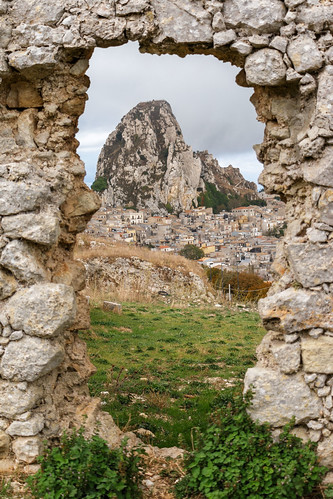
The ancient town of Triokala was destroyed and rebuilt in the Ninth Century by the Arabs under the name of "Kalat al ballut" (stronghold of the oaks).

Here in 1091 King Roger (1031-1101) defeated the Arabs, and in memory of the victory he erected a temple to St. George. The Normans built a castle, where in 1302, between Frederick II of Aragon (1272-1337) and Charles of Valois (1270-1325), the Treaty of Caltabellotta was signed after the war of Vespers, and the island was ceded to the Aragonese.

Caltabellotta became a county in the mid-14th century when King Peter of Aragon (1319-1387) granted the title to Raymond Peralta, who became the poweful Earl of Caltabellotta. The county was ruled by the Peralta until the fifteenth century, when it passed for matrimonial law to the family of De Luna.

The Spanish rule lasted at Caltabellotta until the early 18th century; then the town passed to the Bourbons and finally it entered into the newly formed Kingdom of Italy in 1861.

Caltabellotta: it starts with a legend

According to legend, when Daedalus, the inventor of the Labyrinth, fled from the anger of King Minos, he took refuge on Sicily with Cocalus, a powerful Sicanian king, where he lived for a while and filled the island with his fame. Here he also built 'Kamikos', a city on a rock that was absolutely impregnable.

Meanwhile, King Minos prepared an invasion, and on landing in the territory of Agrigento he turned against Kamikos, asking Cocalus to deliver Daedalus to him. Using deception, Cocalos invited him to a meeting and received Minos hospitably. While Minos went for a bathe, Cocalus 'detained' him in the hot water, that killed him, and then returned the body to the Cretans, saying that he had fallen into the hot water and died.

Schubring emphasized that the legend disguised the fact that Cocalos and Kamikos were attacked by an army from Crete. Schubring's intuition was confirmed by contemporary studies:

“The mythological basis for the military expedition of Minos, in search of Daedalus, who escaped from the Labyrinth and took refuge at the court of the Sicanian King Cocalus, reveals the historical reality of a possible military confrontation between the ancient military powers for the control of the Mediterranean routes, trades and technologies”.

According to tradition, Kamikos was perhaps destroyed in the age of Theron, the tyrant of Akragas (540-472 BC), and abandoned by its inhabitants. With the disappearance of Kamicos, "Triokala" made its appearance. The Greeks called the city by a name that identifies its main properties, namely "Triokala" = three good things: water, fruit, and impregnability.

However it is not a foregone conclusion that Triokala appeared after the disappearance of Kamikos. According to Schubring, Triokala was the fortress of Kamikos, situated on a rocky peak overlooking the town - hence Triokala was the fortress (frourìon) of Kamikos, and the vantage point of the slaves during the first Servile War in Sicily (134-132 BC).

The position of Triokala coincides perfectly with the current town of Caltabellotta.


Monday, February 4, 2013

Manichean Cross


Could this be the original Manichean Cross?:


"Those who advocate using the crucifix in the Syro-Malabar Catholic Church instead of the Mar Thoma Cross claim that the Mar Thoma Cross is actually the "Manichean Cross" a symbol of Manicheanism (a heretical early Christian sect that blended Christian and Zoroastrian beliefs and whose founder, Manichee, claimed to be the incarnation of the Holy Spirit)."

The cross has a dove above it representing the Holy Spirit. The lotus below is meant to represent the Father. The lotus in the East also represents the flowering of great beauty from the sludge and slime. Perhaps here, another symbol of the good overcoming evil and its results.

The following is about the fuss this cross has caused in the Mar Thoma Church:


"The warring factions in the Church could be described as the traditionalists and the reformists. The traditionalists maintain that the Syro-Malabar Church is a daughter-Church of the Chaldean Church with headquarters in Baghdad. They are for the adoption of the whole East Syrian (Chaldean) liturgy said to be prevalent in the Church in Kerala from the fifth century to the 16th century when the Latin Church established its sway with the advent of the Portuguese.
"According to the reformists, the traditionalists are for the removal of the crucifix and abolition of prayers like Rosary and Way of the Cross among other things and for the introduction of `Chaldean vestiges' like the Persian Cross, sanctuary veil and `Bema,' (a separate table to be placed in the front or in the middle of the aisle).

"The crucifix has disappeared from many convents which easily succumbed to the Chaldean propaganda,'' says noted religious scholar Prof. Scaria Zacharia. The crucifix, a matter of great religious and emotional attachment is being replaced by what is called the `Mar Thoma Cross'. The reformists contend that this cross is the Manichean Cross, a symbol of a heretic Church of a non-Catholic origin, which has since become defunct."

Saturday, February 2, 2013

Paraclete & the Redeemed Lucifer

Lucifer and all other adversarial spirits can only live within the Holy Spirit, as all life is encompassed by it.
  A quote from Rudolf Steiner:

That man is capable of this, that he is capable of understanding Christ,  that Lucifer, resurrected in a new form, can unite with Christ as the good Spirit this, as prophecy still, was told by Christ Himself to those around Him, when He said: Ye shall be illumined by the new Spirit, by the Holy Spirit!
This Holy Spirit is none other than the Spirit through whom man can apprehend what Christ has wrought. Christ desired not merely to work, but also to be apprehended, to be understood. Therefore the sending of the Spirit by whom men are inspired, the sending of the Holy spirit, is implicit in Christianity.
In the spiritual sense, Whitsuntide belongs inseparably to Easter. This Holy Spirit is none other than the Lucifer-Spirit, resurrected now in higher, purer glory the Spirit of independent understanding, wisdom-inwoven. Christ Himself foretold that this Spirit would come to men after Him, and in the light of this Spirit their labors must proceed. What is it that works onward in the light of this Spirit? The world-stream of spiritual science, if rightly conceived! What is this spiritual science? It is the wisdom of the Spirit, the wisdom that lifts into the full light of consciousness that in Christianity which would otherwise remain in the unconscious. 

The torch of the resurrected Lucifer, of the Lucifer now transformed into the good, blazons the way for Christ. Lucifer is the bearer of the Light, Christ is the Light! As the word itself denotes, Lucifer is the Bearer of the Light. That is what the spiritual scientific movement should be, that is implicit in it.
Those who know that the progress of mankind depends upon living apprehension of the mighty Event of Golgotha are they who as the Masters of Wisdom and of the Harmony of Feelings are united in the great Guiding Lodge of mankind. And as once the tongues of fire hovered down as a living symbol upon the company of the apostles, so does the Holy Spirit announced by Christ Himself reign as the Light over the Lodge of the Twelve. The Thirteenth is the Leader of the Lodge of the Twelve. The Holy Spirit is the mighty Teacher of those we name the Masters of Wisdom and of the Harmony of Feelings.
It is through them that his voice and his wisdom flow down to mankind in this or that stream upon the earth. The treasures of wisdom gathered together by the spiritual scientific movement in order to understand the universe and the Spirits therein, how through the Holy Spirit into the Lodge of the Twelve; and that is what will ultimately lead mankind step by step to free, self-conscious understanding of Christ and of the Event of Golgotha. Thus to cultivate spiritual science means to  understand that the Spirit has been  sent into the world by Christ; the pursuit of spiritual science is implicit in true Christianity. 

We find in "Parzifal" that his mother, the pregnant Herzeleide, nurses a young dragon in a dream:
For she did nurse a dragon, that
forth from her body sprung,
And its dragon-life to nourish awhile
at her breast it hung,
Then it fled from her sight so swiftly..

The ultimate redemption of Evil through Good appears in Mani himself.

Mani speaking at the age of 24: 

"This is how everything that has happened and that will happen was unveiled to me by the Paraclete", Mani says in the Kephalia, mentioning "everything the eye shall see, and the ear hear, and the thought think". 

"I have understood by him everything. I have seen the totality through him. I have become a single body with a single spirit."

 "The divine counterpart will appear and bring help to every apostle (Keph. 36: 6–9)" and not just one person. 


Friday, February 1, 2013

Eightfold Path


The city of Petalamund (Petal Mount) appears in verses in Eschenbach's Parsifal. It has sixteen gates and is besieged by a black (Blackamoor) army on eight of the gates and a white army on the other eight. Here is a picture of the throat lotus blossom or chakram. Eight of the petals (those besieged by the Moorish army) have been developed through grace, the other eight require working on by the individual.

 This is a most practical way in the which noble eightfold path has been incorporated into the Christian context.

Rudolf Steiner suggested these exercises for students who wished to enhance these qualities:


For the Days of the Week

The pupil must pay careful attention to certain activities in the life of soul which in the ordinary way are carried on carelessly and inattentively.
There are eight such activities.

It is naturally best to undertake only one exercise at a time, throughout a week or a fortnight, for example, then the second, and so on, then beginning over again. Meanwhile it is best for the eighth exercise to be carried out every day. True self-knowledge is then gradually achieved and any progress made is perceived. Then later on - beginning with
Saturday - one exercise lasting for about five minutes may perhaps be added daily to the eighth so that the relevant exercise will occasionally fall on the same day. Thus: Saturday - Thoughts; Sunday - Resolves; Monday - Talking; Tuesday - Actions; Wednesday - Behavior, and so on.

SATURDAY

To pay attention to one's ideas.

To think only significant thoughts. To learn little by little to separate in one's thoughts the essential from the nonessential, the eternal from the transitory, truth from mere opinion.

In listening to the talk of one's fellow-men, to try and become quite still inwardly, foregoing all assent, and still more all unfavorable judgments (criticism, rejection), even in one's thoughts and feelings.

This may be called:

`RIGHT OPINION'.


SUNDAY

To determine on even the most insignificant matter only after fully reasoned deliberation. All unthinking behaviour, all meaningless actions, should be kept far away from the soul. One should always have well- weighed reasons for everything. And one should definitely abstain from doing anything for which there is no significant reason.

Once one is convinced of the rightness of a decision, one must hold fast to it, with inner steadfastness.

This may be called:

`RIGHT JUDGMENT'.

having been formed independently of sympathies and antipathies.


MONDAY

Talking. Only what has sense and meaning should come from the lips of one striving for higher development. All talking for the sake of talking - to kill time - is in this sense harmful.

The usual kind of conversation, a disjointed medley of remarks, should be avoided. This does not mean shutting oneself off from intercourse with one's fellows; it is precisely then that talk should gradually be led to significance. One adopts a thoughtful attitude to every speech and answer
taking all aspects into account. Never talk without cause - be gladly silent. One tries not to talk too much or too little. First listen quietly; then reflect on what has been said.

This exercise may be called:

`RIGHT WORD'.


TUESDAY

External actions. These should not be disturbing for our fellow-men. Where an occasion calls for action out of one's inner being, deliberate carefully how one can best meet the occasion - for the good of the whole, the lasting happiness of man, the eternal.

Where one does things of one's own accord, out of one's own initiative: consider most thoroughly beforehand the effect of one's actions.

This is called:

`RIGHT DEED'.


WEDNESDAY

The ordering of life. To live in accordance with Nature and Spirit. Not to be swamped by the external trivialities of life. To avoid all that brings unrest and haste into life. To hurry over nothing, but also not to be indolent. To look on life as a means for working towards higher development and to behave accordingly.

One speaks in this connection of

`RIGHT STANDPOINT'.


THURSDAY


Human Endeavor. One should take care to do nothing that lies beyond one's powers - but also to leave nothing undone which lies within them.

To look beyond the everyday, the momentary, and to set oneself aims and ideals connected with the highest duties of a human being. For instance, in the sense of the prescribed exercises, to try to develop oneself so that afterwards one may be able all the more to help and advise one's fellow- men - though perhaps not in the immediate future.

This can be summed up as:

`TO LET ALL THE FOREGOING EXERCISES BECOME A HABIT'.


FRIDAY

The endeavor to learn as much as possible from life.

Nothing goes by us without giving us a chance to gain experiences that are useful for life. If one has done something wrongly or imperfectly, that becomes a motive for doing it rightly or more perfectly, later on.

If one sees others doing something, one observes them with the like end in view (yet not coldly or heartlessly). And one does nothing without looking back to past experiences which can be of assistance in one's decisions and achievements.

One can learn from everyone - even from children if one is attentive.

This exercise is called:

`RIGHT MEMORY'.

(Remembering what has been learnt from experiences).


SUMMARY

To turn one's gaze inwards from time to time, even if only for five minutes daily at the same time. In so doing one should sink down into oneself, carefully take counsel with oneself, test and form one's principles of life, run through in thought one's knowledge - or lack of it - weigh up one's duties, think over the contents and true purpose of life, feel genuinely pained by one's own errors and imperfections. In a word:
labor to discover the essential, the enduring, and earnestly aim at goals in accord with it: for instance, virtues to be acquired. (Not to fall into the mistake of thinking that one has done something well, but to strive ever further towards the highest standards.)

This exercise is called:

`RIGHT EXAMINATION'.