Translate

Wednesday, January 30, 2019

Christianity of the Sixth Root Race


Manes will create an overlapping stream, a stream which goes further than the stream of the Rosicrucians. The stream of Manes goes over to the Sixth Root Race which has been in preparation since the founding of Christianity. Christianity will appear in its perfected form in the Sixth Root Race. 

Life as such overcomes every Form. It propagates itself through Christianity and lives in all forms and confessions. Whoever seeks the Christian Life will find it. It creates Forms and shatters Forms. But, in addition, a form for the Christian Life of the Sixth Root Race must be prepared. A number of human beings must be formed into an organization, a Form, in which the Christianity of the Sixth Root Race can find its place. This Form, this external Form of Society must spring from a handful of men whom Manes prepares. This is the community that Manes prepares. Therefore the first endeavor of Manicheanism is to shape external life in its pure form. That is why Manicheanism laid such great stress on purity. The Cathari were a sect which appeared like a meteor. They gave themselves this name, Cathari, because Cathari means ‘the Pure Ones.’ They were human beings who had to keep themselves pure in their mode of life and in their moral relationships. 


In Manicheanism, it was less a question of the cultivation of Life but rather of the cultivation of the external Form of Life for the Sixth Root Race. In this Sixth Root Race, Good and Evil will form a far greater contrast than they do today. What will appear in the Fifth Round for the whole of humanity, i.e., that the physiognomy will be a direct expression for that which karma has created in man, so, in the Sixth Root Race, Evil will appear, especially in the Spiritual. There will be men who are mighty in Love and Goodness. But Evil will also be there as a mood and a disposition (Gesinnung) without any covering, within a large number of human beings. They will extol Evil. Some inkling in regard to the Evil in the Sixth Root Race glimmers in many men of genius. (Nietzsche's Blond Beast is a portent of this Evil in the Sixth Root Race.)

The task of the Sixth Root Race is to draw Evil again into itself through gentleness (Milde). In those who are the followers of the Sons of the Widow there will live the inviolable principle that Evil must be overcome through gentleness. That is the task of the Manichean spiritual stream. It appears in forms which many can call to mind, and need not be mentioned. It must express itself in the forming of a community which has to spread above all things: Peace, Love, and Non-resistance to Evil. It must create a Form for the Life that is to come later. 


-Rudolf Steiner, Berlin - November 11, 1904 - S-0948 - GA 93


Translation of brief notes made by Fraulein Scholl. Several passages in the German are very obscure.


Tuesday, January 15, 2019

Wagner & Buddhism


There is an amalgamation of Buddhism and Christianity in "Parsifal". This, as we know, is also one of the hallmarks of Manichaeism.

Richard Wagner was very well read in Buddhism, and incorporated it in his operas:

The name "Tristan" means sorrow and sadness (the world of Samsara). It is the sadness of separation from God:


"It might also be argued that there are no specifically Buddhist ideas in Tristan.....The subject of his Tristan und Isolde is not salvation but the suffering caused by the desire for extinction.
"Whether that deliverance or extinction takes the form of absorption into Brahman or transition into Nirvana is unimportant, in the context of the drama. From a remark that Wagner made to Cosima many years later, that Kundry had undergone Isolde's transfiguration a thousand times, it would appear that he had reached the view that Isolde had not yet escaped from samsara, which in notes in the Brown Book he equated to the realm of day; in contrast, Nirvana was the realm of night. So there is sufficient evidence from which to conclude that, if not during the composition of Tristan und Isolde then at least in reflecting on it later, Wagner thought of Tristan yearning for Nirvana, the realm of night."
-Derrick Everett
In the Wagnerian Parsifal, he shoots a swan: 


"Off with you, be on your way!
Take some advice from Gurnemanz:
In future leave our swans in peace,
go seek -- you gander -- for geese!"


"Much later, in Parzival's wanderings, he comes across a goose that has been wounded by King Arthur's falcon. Three drops of blood fall on the snow; the red on white reminds Parzival of his distant wife, Condwiramurs. In contemplation of the blood on the snow, he falls into a trance."

The three drops of blood on the snow is also scene from the beginning of Snow White. The young Queen pricks her finger while sewing and three drops of blood fall onto the snow.

⇋⇋⇋⇋⇋


In the writings of Basil Valentinus the Swan represents the third level of initiation- Raven and Peacock being 1st and 2nd. In this level Inspiration as the Divine Word, the Harmony of the Spheres, sounds forth.

"In the third degree he meets death and must sing the Swan's song. He then dies to everything earthly."

-Notes from Walter Stein's The Ninth Century.


From Edwin Arnold's "Light of Asia"-

It happened one vernal day that a wild swan was shot by an idle courtier as the flock flew near the palace, and the wounded bird fell into the hands of Siddârtha. As he soothed the frightened, fluttering bird with tender touch, and drew the arrow from its side, he pressed the barb into his own wrist to make trial of the pain: --

Then some one came who said, "My Prince hath shot
A swan, which fell among the roses here.
He bids me pray you send it. Will you send?
"Nay," quoth Siddârtha, "if the bird were dead
To send it to the slayer might be well,
But the swan lives; my cousin hath but killed
The god-like speed which throbbed in this white wing."

And Devadatta answered, "The wild thing,
Living or dead, is his who fetched it down;
'Twas no man's in the clouds, but fall'n't is mine,
Give me my prize, fair Cousin." Then our Lord
Laid the swan's neck beside his own smooth cheek
And gravely spake, "Say no! the bird is mine,
The first of myriad things which shall be mine
By right of mercy and love's lordliness.
For now I know, by what within me stirs,
That I shall teach compassion unto men
And be a speechless world's interpreter,
Abating this accursed flood of woe"
(end of quote)


"In Wieland Wagner's interpretation of Parsifal, the spiritual hero progressed from the realm of mother and matter, symbolised by the swan, to the realm of father and spirit, symbolised by the dove. In this interpretation the incident with the swan can be seen as the starting point of Parsifal's journey and the descending dove as the end of that journey. In Wieland's famous Bayreuth production (1951-1973), however, the dove was omitted. Perhaps because this symbol suggests a parallel between Parsifal and Christ, one that Richard Wagner repeatedly denied had been his intention."

Kundry is the Kundalini:

Then someone chances upon her in a cave, or in dense undergrowth, in a deathlike sleep, lifeless, numb, bloodless, with all limbs rigid.

-Wagner's Prose Draft of 1865

After Parsfal's destiny is played out another union takes place - that of Parsifal with his wife Kondawiramur. They meet where Parsifal once saw three drops of blood in the snow. It was on this spot that he fell into a state of continuing dream while overpowerd by desire for her. Now all this is overcome. His love is now free from egoism. It has become a healing love which, stripped of all egotistic desire, is a free and radiant blessing- like the light of the sun it streams over the world.

-T. Ravenscroft The Cup of Destiny

Tuesday, November 27, 2018

What is Spiritual Manifests itself in the Form of Matter

"Manichaeism recognised a reality in which sense and super-sense are  blended; for it the words and concepts "matter and "spirit" have as  yet no contrasting meaning."

"In defining it, it must be pointed out that the general outlook of this philosophy is more important than what can be described as its  actual content. The first and most remarkable thing about it is that the division of human experience into a spiritual and a material side  had no meaning for it. The words or ideas "spirit" and "matter" convey no distinction to it. It sees the spiritual in what appears to the senses as material, and when it speaks of the spiritual it does not rise above that which manifests itself to the senses.

"It is true to say of Manichaeism- much more so than the abstract and intellectual world of today can realise- that it actually saw  spiritual phenomena, spiritual facts, in the stars and their courses, and that in the mystery of the Sun it saw a spiritual reality manifesting itself to us on earth. It conveys no meaning for Manichaeism to speak of matter and spirit separately, for to the Manichaean what is spiritual manifests itself in the form of matter, and that which appears as material is itself spiritual. 


"Therefore Manichaeism speaks quite naturally of astronomical things and world-phenomona in the same way that it would speak of moral phenomena or happenings within the evolution of the human race. Thus, the existence side by side of "light" and "darkness" which - imitating something from ancient Persia- it embodies in its philosophy is both a physical and a spiritual fact. In the same way Manichaeism speaks of the Sun in its movements in the heavens as related to the moral realities and impulses in the development of mankind. It sees the relation of this "spiritual physical" Sun to the signs of the Zodiac, as the relation of the Original Being, the source of the world's light, to the twelve Beings through whom He delegates his activities."

-The Redemption of Thinking, Rudolf Steiner

Monday, November 19, 2018

Pure Light


Look at the light as it touches unevenly all that it falls upon. See here a shadow, see here a great spark, on the leaves, on the tops of that which it fires.

There are gradients of light, the way in which the scene is lit, and one may focus best upon the shadows, or upon the most brilliant.
Seek, with your eyes, the shiniest, brightest places within the
scene. Go to them, and ask, what inhabits these brightest places.
They will shift, but they will be present, wherever kissed by the radiance. They are much illumined. Keep looking. See where it is the light falls, and know that this makes a difference, not only to your vision, but to those places where it is most intense. It may be in reflection, it may be in direct sunshine, look around to the brightest places, keep looking.


"Oh, Great and Wonderful One, He who brings this Light: the Light, not in symbol, but in actuality - where should we be, without this intensity? I am humbled, I am grateful, I rejoice this vision granted. And I know, that help is at hand, wherever Thy Radiance falls. Pure Light. Why do I take thee for granted? Why have I cared not to see you? I look to all else, that by your Power, is made known to me, but not at the actual Light itself. The brightest part of the Light."

Look, really look, into the those places lit so brightly: look, at
the light itself. By contrast we may experience those places where the light is at its brightest - it is the very contrast that enables us to do so, and it would be hard to imagine a world without contrast, if all images were indeed the same, without the palette of gradient light.

-B.Hive 🌞

In some dim way, to realize the etheric as etheric, then one begins to move forward into a kind of new and more intimate relationship with the world of plants. One begins, for instance, to feel, like a sort of tenderness in one's own heart, the infinite delicacy and tenderness that hovers about the growing point commonest weed. And at the same time or it may well be later - it come about that one will begin to feel a new, and again an intimate, relation with the light itself. One begins to perceive, or rather to feel, that the light itself- this light from the sun that comes to us through the senses - is etheric and that the etheric is a kind of light.

And this is a very deeply moving experience. Much deeper than mere observation. It goes to the roots of one's being, like the breath of life itself. One will begin to feel that the light is not only outside in space, but also within oneself. Indeed there are sure to be occasions when, for brief periods, one is aware, not only of seeing or feeling the light, but also of breathing it. Breathing it in and out, but especially in.


Only a much more intimate kind of breathing so that one will feel –at times that one is in the light, not only as our bodies are in water when they swim, not only as they are in the air we breathe, but rather as we speak, in that significant English idiom, of people being in love. If one had to find a single word in which to sum up the more subjective aspect experience I am speaking of, there is only one word that could be used and that is - joy. The sort of joy that we see made manifest in the sunlight dancing on the water. Deep draughts of pure joy, which obliterate, while they last all anxiety, all sorrow, all considerations of karma, and even all memory of such things. A joy so uplifting and, if I may use the word, so thoroughgoing, that however short a time it lasts, it will leave some enduring effects behind it. It may indeed somewhat affect the whole personality - with reverberations even into the sphere of physical health.

-Owen Barfield

Tuesday, April 5, 2016

Klingsor's Evil Arts


Arabian Black Magic was studied by Klingsor:
"All this is closely connected with a figure who glimmers across from the Middle Ages as a legendary being, but is well know to anyone acquainted with the nature of the Mysteries: a personality who was quite real in the middle of the Middle Ages, Klingsor, the Duke of Terra de Labur, a district we have to look for in what is now Southern Calabria.
From there were carried out the incursions of the enemy of the Grail, especially over to Sicily. Even as today, if we tread Sicilian soil and have occult sight, we are aware of the Akashic after-effects of the great Empedocles still present in the atmosphere, so we can still perceive there the evil after-effects of Klingsor, who allied himself from his Duchy of Terra de Labur, across the Straits of Messina, with those enemies of the Grail who occupied the fastness known in occultism and in legend as Calot bobot."

-Rudolf Steiner

"Calot Bobot" or "Kalot Enbolot" - from the Arabic Qalat-al-ballut - means "Castle of the Oaks". From there, African Mohammedan enemies of the Grail worked. The symbol of the Grail is the Sun host held by the crescent Moon. The Moon forces will be redeemed by the Sun. It is opposed by the crescent with the star (the false Venus?).

So today we have the old battle of the Sons of the Sun with the Sons of the Moon. Walter Stein predicted the confrontation between East and West.


Working with the time cycles of Trithemius of Sponheim he saw a replay of the battle of Salamis of 480 BC, where the Persians were beaten back by the Greeks. He predicted that two old enemies would have to cooperate if the battle were to be won.

"In the middle of the Middle Ages, Calot Bobot in Sicily was the seat of the goddess called Iblis, the daughter of Eblis; and among all evil unions which have taken place within the Earth's evolution between beings in whose souls there were occult forces, the one known to occultists as the worst of all was between Klingsor and Iblis, the daughter of Eblis. Iblis, by her very name, is characterized as being related to Eblis, and in Mohammedan tradition Eblis is the figure we call Lucifer.
"Iblis is a kind of feminine aspect of Eblis, the Mohammedan Lucifer, and with her the evil magician Klingsor united his own evil arts, through which in the Middle Ages he worked against the Grail. These things must needs find expression in pictures, but in pictures that correspond to realities; they cannot be expressed in abstract ideas. And the whole of the hostility to the Grail was enacted in that fastness of Iblis, Calot bobot whither the remarkable Queen Sibilla had fled with her son William, in 1194, under the rulership of the Emperor Henry V1."

-Rudolf Steiner
As the story goes, Klingsor was found in bed with the king of Sicily's wife, Iblis. For this indiscretion Klingsor had "yield his manhood to the king in satisfaction".

-Walter Stein The Ninth Century

As a result Klingsor was made a "capon" a "castrated cock".

May we commit to the higher path, and not the stupidity of Klingsor.


"Death dies. Evility does not thrive; it exists, corrupts and then falls to its own design. Hatreds are self-inflicting. Even the wars in Heaven are but a thumping and a clanging of but a toy drum and cymbal to the serene and holy hierarchies.


"By their own nature those who offend Father God by their intent, by their behavior, will be unarmored, incapacitated and laid victim to the same ranks they themselves have led through their short-lived victories.


"Then let them step amongst the slush of once flesh, and feel the edge of every tendon, every sinew - for each sightless eye, twisted or dismembered limb, for any premature and violent end, they too, in trade, shall be thus unendowed.


"Where now the strength that once was arm?
Cannot the finger point, or curl -
Or hold thy heavy crown?"

-B.Hive, Question on Pacifism,10th November 2001


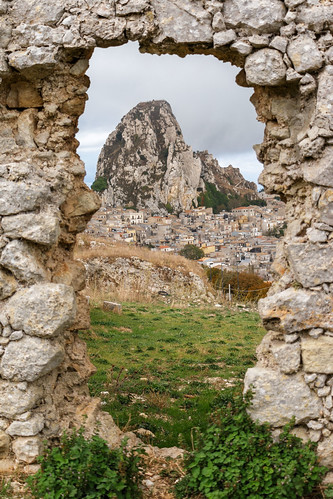
The ancient town of Triokala was destroyed and rebuilt in the Ninth Century by the Arabs under the name of "Kalat al ballut" (stronghold of the oaks).

Here in 1091 King Roger (1031-1101) defeated the Arabs, and in memory of the victory he erected a temple to St. George. The Normans built a castle, where in 1302, between Frederick II of Aragon (1272-1337) and Charles of Valois (1270-1325), the Treaty of Caltabellotta was signed after the war of Vespers, and the island was ceded to the Aragonese.

Caltabellotta became a county in the mid-14th century when King Peter of Aragon (1319-1387) granted the title to Raymond Peralta, who became the poweful Earl of Caltabellotta. The county was ruled by the Peralta until the fifteenth century, when it passed for matrimonial law to the family of De Luna.

The Spanish rule lasted at Caltabellotta until the early 18th century; then the town passed to the Bourbons and finally it entered into the newly formed Kingdom of Italy in 1861.

Caltabellotta: it starts with a legend

According to legend, when Daedalus, the inventor of the Labyrinth, fled from the anger of King Minos, he took refuge on Sicily with Cocalus, a powerful Sicanian king, where he lived for a while and filled the island with his fame. Here he also built 'Kamikos', a city on a rock that was absolutely impregnable.

Meanwhile, King Minos prepared an invasion, and on landing in the territory of Agrigento he turned against Kamikos, asking Cocalus to deliver Daedalus to him. Using deception, Cocalos invited him to a meeting and received Minos hospitably. While Minos went for a bathe, Cocalus 'detained' him in the hot water, that killed him, and then returned the body to the Cretans, saying that he had fallen into the hot water and died.

Schubring emphasized that the legend disguised the fact that Cocalos and Kamikos were attacked by an army from Crete. Schubring's intuition was confirmed by contemporary studies:

“The mythological basis for the military expedition of Minos, in search of Daedalus, who escaped from the Labyrinth and took refuge at the court of the Sicanian King Cocalus, reveals the historical reality of a possible military confrontation between the ancient military powers for the control of the Mediterranean routes, trades and technologies”.

According to tradition, Kamikos was perhaps destroyed in the age of Theron, the tyrant of Akragas (540-472 BC), and abandoned by its inhabitants. With the disappearance of Kamicos, "Triokala" made its appearance. The Greeks called the city by a name that identifies its main properties, namely "Triokala" = three good things: water, fruit, and impregnability.

However it is not a foregone conclusion that Triokala appeared after the disappearance of Kamikos. According to Schubring, Triokala was the fortress of Kamikos, situated on a rocky peak overlooking the town - hence Triokala was the fortress (frourìon) of Kamikos, and the vantage point of the slaves during the first Servile War in Sicily (134-132 BC).

The position of Triokala coincides perfectly with the current town of Caltabellotta.


Monday, February 4, 2013

Manichean Cross


Could this be the original Manichean Cross?:


"Those who advocate using the crucifix in the Syro-Malabar Catholic Church instead of the Mar Thoma Cross claim that the Mar Thoma Cross is actually the "Manichean Cross" a symbol of Manicheanism (a heretical early Christian sect that blended Christian and Zoroastrian beliefs and whose founder, Manichee, claimed to be the incarnation of the Holy Spirit)."

The cross has a dove above it representing the Holy Spirit. The lotus below is meant to represent the Father. The lotus in the East also represents the flowering of great beauty from the sludge and slime. Perhaps here, another symbol of the good overcoming evil and its results.

The following is about the fuss this cross has caused in the Mar Thoma Church:


"The warring factions in the Church could be described as the traditionalists and the reformists. The traditionalists maintain that the Syro-Malabar Church is a daughter-Church of the Chaldean Church with headquarters in Baghdad. They are for the adoption of the whole East Syrian (Chaldean) liturgy said to be prevalent in the Church in Kerala from the fifth century to the 16th century when the Latin Church established its sway with the advent of the Portuguese.
"According to the reformists, the traditionalists are for the removal of the crucifix and abolition of prayers like Rosary and Way of the Cross among other things and for the introduction of `Chaldean vestiges' like the Persian Cross, sanctuary veil and `Bema,' (a separate table to be placed in the front or in the middle of the aisle).

"The crucifix has disappeared from many convents which easily succumbed to the Chaldean propaganda,'' says noted religious scholar Prof. Scaria Zacharia. The crucifix, a matter of great religious and emotional attachment is being replaced by what is called the `Mar Thoma Cross'. The reformists contend that this cross is the Manichean Cross, a symbol of a heretic Church of a non-Catholic origin, which has since become defunct."

Saturday, February 2, 2013

Paraclete & the Redeemed Lucifer

Lucifer and all other adversarial spirits can only live within the Holy Spirit, as all life is encompassed by it.
  A quote from Rudolf Steiner:

That man is capable of this, that he is capable of understanding Christ,  that Lucifer, resurrected in a new form, can unite with Christ as the good Spirit this, as prophecy still, was told by Christ Himself to those around Him, when He said: Ye shall be illumined by the new Spirit, by the Holy Spirit!
This Holy Spirit is none other than the Spirit through whom man can apprehend what Christ has wrought. Christ desired not merely to work, but also to be apprehended, to be understood. Therefore the sending of the Spirit by whom men are inspired, the sending of the Holy spirit, is implicit in Christianity.
In the spiritual sense, Whitsuntide belongs inseparably to Easter. This Holy Spirit is none other than the Lucifer-Spirit, resurrected now in higher, purer glory the Spirit of independent understanding, wisdom-inwoven. Christ Himself foretold that this Spirit would come to men after Him, and in the light of this Spirit their labors must proceed. What is it that works onward in the light of this Spirit? The world-stream of spiritual science, if rightly conceived! What is this spiritual science? It is the wisdom of the Spirit, the wisdom that lifts into the full light of consciousness that in Christianity which would otherwise remain in the unconscious. 

The torch of the resurrected Lucifer, of the Lucifer now transformed into the good, blazons the way for Christ. Lucifer is the bearer of the Light, Christ is the Light! As the word itself denotes, Lucifer is the Bearer of the Light. That is what the spiritual scientific movement should be, that is implicit in it.
Those who know that the progress of mankind depends upon living apprehension of the mighty Event of Golgotha are they who as the Masters of Wisdom and of the Harmony of Feelings are united in the great Guiding Lodge of mankind. And as once the tongues of fire hovered down as a living symbol upon the company of the apostles, so does the Holy Spirit announced by Christ Himself reign as the Light over the Lodge of the Twelve. The Thirteenth is the Leader of the Lodge of the Twelve. The Holy Spirit is the mighty Teacher of those we name the Masters of Wisdom and of the Harmony of Feelings.
It is through them that his voice and his wisdom flow down to mankind in this or that stream upon the earth. The treasures of wisdom gathered together by the spiritual scientific movement in order to understand the universe and the Spirits therein, how through the Holy Spirit into the Lodge of the Twelve; and that is what will ultimately lead mankind step by step to free, self-conscious understanding of Christ and of the Event of Golgotha. Thus to cultivate spiritual science means to  understand that the Spirit has been  sent into the world by Christ; the pursuit of spiritual science is implicit in true Christianity. 

We find in "Parzifal" that his mother, the pregnant Herzeleide, nurses a young dragon in a dream:
For she did nurse a dragon, that
forth from her body sprung,
And its dragon-life to nourish awhile
at her breast it hung,
Then it fled from her sight so swiftly..

The ultimate redemption of Evil through Good appears in Mani himself.

Mani speaking at the age of 24: 

"This is how everything that has happened and that will happen was unveiled to me by the Paraclete", Mani says in the Kephalia, mentioning "everything the eye shall see, and the ear hear, and the thought think". 

"I have understood by him everything. I have seen the totality through him. I have become a single body with a single spirit."

 "The divine counterpart will appear and bring help to every apostle (Keph. 36: 6–9)" and not just one person.